
V
EXPLORE SRI LANKA
PLAN YOUR JOURNEY
CEYLON VELOSRI LANKA
Wildlife & Safari
Udawalawe National Park Safari: The Complete Guide
August 12, 2026 9 min read
ELEPHANTS, CONSERVATION AND THE DRY-ZONE LANDSCAPE
Udawalawe offers one of Sri Lanka's clearest introductions to elephant country.
Its open grasslands, scrub, water and reservoir-influenced habitats create a landscape where large mammals can sometimes be observed more openly than in dense forest.
The Department of Wildlife Conservation lists Udawalawe among Sri Lanka's most visited national parks and explains that Udawalawe was among parks declared to protect catchments and provide habitat for wildlife displaced by large irrigation developments.
Official Sri Lanka Tourism repeatedly highlights the park for Sri Lankan elephant viewing and includes it in wildlife itineraries alongside the nearby Elephant Transit Home.
THE LANDSCAPE
Udawalawe's character is closely tied to water. The reservoir and surrounding catchment shaped both the protected area's history and its ecology.
Open grassland, scrub and patches of forest provide feeding and shelter for different species. For visitors, the relative openness can make animal behavior easier to observe than in heavily wooded habitats.
WILD ELEPHANTS
Elephants are the species most strongly associated with Udawalawe. A safari may reveal solitary bulls, small groups or family units depending on where animals are moving and feeding.
The important word is wild. They choose their own direction, distance and behavior. A good safari vehicle does not block a crossing or approach a herd simply to create a close photograph.
Particular care is needed around calves and family groups. If an elephant shows discomfort, the vehicle should give more space.
BEYOND ELEPHANTS
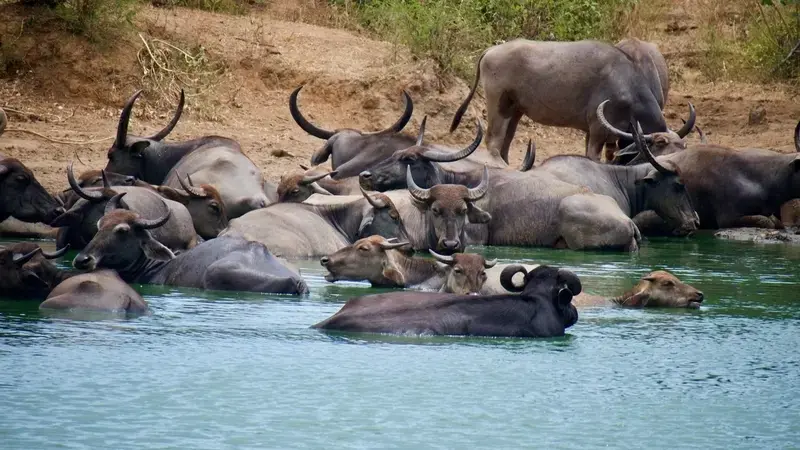
Udawalawe should not become an elephant-only checklist. Water buffalo, spotted deer, sambar, wild boar, crocodiles, monkeys and smaller mammals may all be part of the drive.
The park is also rewarding for birds. Raptors are a particular attraction, while water bodies and grassland support a wide range of other species.
A guide who can identify birds makes quiet periods between mammal sightings far more interesting.
MORNING OR AFTERNOON?
Both early-morning and afternoon safaris can work well. Cooler periods are generally more comfortable for visitors and can coincide with increased animal movement.
Wildlife does not follow a tourist timetable, so choose the session that fits the itinerary and current local conditions rather than expecting one guaranteed 'best' time.
SAFARI STYLE
A typical visit uses a permitted 4WD safari vehicle. The open landscape can tempt drivers to hurry toward visible elephants, but responsible observation requires patience and distance.
Ask for a guide or driver who values natural behavior over proximity. Quietly watching an elephant feed for ten minutes is usually more meaningful than rushing between several brief sightings.
ELEPHANT TRANSIT HOME
The nearby Elephant Transit Home adds an important conservation dimension to an Udawalawe visit. Official Sri Lanka Tourism describes it as a place where orphaned elephant calves are rehabilitated for life in the wild.
The ethical value lies precisely in rehabilitation and eventual release, not in creating direct-contact entertainment for tourists. Visitors should follow current viewing arrangements and avoid expecting touching, bathing or riding experiences.
Seeing young elephants in rehabilitation and then observing truly wild elephants inside the park can help travelers understand the difference between conservation care and wildlife entertainment.
ELEPHANT ETHICS IN SRI LANKA
Elephants are culturally important and economically significant to tourism, but close-contact attractions require careful scrutiny. For Ceylon Velo, a wildlife experience should prioritize wild observation or genuine rehabilitation.
Feeding, forced interaction and activities designed mainly for tourist photographs are not part of the safari experience we want to promote.
PHOTOGRAPHY
Udawalawe's open habitat works well for environmental photographs showing elephants within grassland and sky rather than only close portraits. A telephoto lens allows respectful distance.
Keep cameras inside the vehicle profile when an animal is close and follow the guide's safety instructions. Bird photographers should also remain alert: raptors and water-associated species can provide excellent opportunities.
WHAT TO BRING
• Water and sun protection
• Neutral lightweight clothing
• Binoculars
• Camera with a moderate telephoto lens if available
• Dust protection for electronics
• A light layer for early starts
FAMILIES AND FIRST-TIME SAFARI TRAVELERS
Udawalawe can be a strong first safari because the landscape is visually open and elephants are a major focus. Children who enjoy animals may find it easier to stay engaged than during a very long search in dense forest.
Still, several hours in a jeep can be tiring. Choose a duration appropriate to the child, bring water and snacks where permitted, and keep expectations realistic.
UDAWALAWE, YALA OR BOTH?
Choose Udawalawe when elephants are the central interest or when the route between the south and hill country makes it convenient.
Choose Yala when the traveler especially wants the broader predator-focused safari reputation and diverse southeastern habitats.
Choose both when wildlife is a major theme and the itinerary has enough time. The landscapes and emphasis are different enough to complement each other.
WHERE IT FITS
Udawalawe is strategically useful between the southern coast and Ella or the central highlands. It can break up a transfer with a meaningful wildlife stay instead of turning the day into hours of driving only.
Travelers coming from Tangalle, Mirissa or other southern areas can continue inland after the safari, while those descending from the hills can use Udawalawe before reaching the coast.
RESPONSIBLE TRAVEL
Stay inside the vehicle except where current rules allow otherwise. Never feed wildlife. Do not ask drivers to approach calves or block an elephant's route.
Carry all waste out, keep noise low and choose legitimate safari services that comply with Department of Wildlife Conservation requirements.
The best elephant encounter is one where the animal continues behaving naturally after the vehicle arrives.
FREQUENTLY ASKED QUESTIONS
• Is Udawalawe good for elephants? Yes. It is one of the Sri Lankan national parks most strongly associated with wild elephant viewing, though no sighting is guaranteed.
• Is the Elephant Transit Home an orphanage? It is a rehabilitation facility for orphaned young elephants, with the goal of returning suitable animals to the wild.
• Can tourists touch the elephants? A responsible rehabilitation visit should not be based on direct tourist handling. Follow current official viewing arrangements.
• Morning or afternoon safari? Both can work. Weather and wildlife movement vary.
• Can I combine Udawalawe with Ella? Yes. It fits naturally on routes between the south and hill country.
• Should I visit both Yala and Udawalawe? If wildlife is a major interest and the itinerary has time, the two parks offer complementary experiences.
FINAL THOUGHTS
Udawalawe is memorable because elephants can be experienced as animals within a landscape, not as performers.
Watch how a trunk selects grass, how a herd keeps calves protected, how an individual chooses to cross a track or remain at a distance. Those ordinary behaviors are the real privilege.
At Ceylon Velo, that is the experience we protect: enough proximity to appreciate the animal, enough distance for it to remain wild.
Written By
Ceylon Velo
Lead Travel Curator at Ceylon Velo with a passion for uncovering the untold stories of the island.
Join the Journey
Subscribe to receive exclusive travel guides and island stories directly in your inbox.