
V
EXPLORE SRI LANKA
PLAN YOUR JOURNEY
CEYLON VELOSRI LANKA
Culture & Local Life
Traditional Sri Lankan Cooking: The Complete Guide
June 6, 2026 10 min read
SPICES, COCONUT, CURRIES AND THE PEOPLE BEHIND THE MEAL
Sri Lankan food makes more sense once you cook it.
At the table, a rice-and-curry meal can look like a collection of small dishes. In the kitchen, you begin to see the logic: coconut softens heat, lime sharpens a sambol, roasted spices deepen aroma, curry leaves change in hot oil, and several mild and strong dishes are designed to be eaten together.
Official Sri Lanka Tourism describes rice and curry as a mainstay of Sri Lankan eating and highlights hoppers, string hoppers, pittu and roti among the island's distinctive foods.
WHAT MAKES SRI LANKAN COOKING DIFFERENT
Sri Lankan cooking uses many ingredients shared with South Asia and the wider Indian Ocean, but the combinations and techniques create a distinct cuisine.
Coconut appears in milk, cream, freshly scraped form and sambols. Spices may be used whole, ground, roasted or unroasted. Curry leaves, pandan, chilli, lime, tamarind or goraka can shift the balance of a dish.
The aim is not to make every curry equally spicy. A full meal often depends on contrast.
RICE AND CURRY IS A SYSTEM, NOT ONE DISH
Official Sri Lanka Tourism describes rice and curry as a central meal and notes the wide range of vegetable, meat and fish curries, pickles, sambols and papadum that can accompany rice.
A cooking class should therefore teach how dishes work together.
A creamy dhal, a dry vegetable curry, a sharper sambol and a richer protein curry may all play different roles on the same plate.
COCONUT: THE ESSENTIAL INGREDIENT
Coconut is one of the most important foundations of Sri Lankan home cooking.
Freshly scraped coconut may become pol sambol. Coconut milk can create body in curries. Thicker and thinner coconut milk may be used at different stages of cooking.
Seeing coconut prepared by hand helps explain why packaged coconut products can change the taste and texture of a recipe.
SPICES AND ROASTING
Tourists often assume Sri Lankan cooking is simply about adding many spices. Technique matters more than quantity.
Roasted curry powder develops a deeper, darker flavor and is often used differently from unroasted spice mixtures. Whole spices can be tempered in hot oil to release aroma.
A good class lets travelers smell ingredients before and after heating so the transformation becomes obvious.
CURRY LEAVES AND PANDAN
Curry leaves are used for aroma rather than eaten as the main ingredient. Pandan, known locally as rampe, brings another distinctive fragrance to many savory dishes.
These ingredients are difficult to understand from a written recipe alone. Handling and smelling them in a kitchen gives immediate context.
SAMBOLS
Sambols provide freshness, heat, texture and acidity.
Pol sambol commonly combines coconut with chilli, onion and lime, with household variations. Lunu miris is another strong condiment associated with foods such as hoppers.
Preparing a sambol by hand also demonstrates how Sri Lankan meals use uncooked elements to balance cooked curries.
HOPPERS
Official Sri Lanka Tourism describes hoppers as bowl-shaped pancakes made from fermented rice flour and coconut milk, cooked in small round pans with crisp edges and a thicker center.
Plain hoppers may be served with lunu miris and curry, while egg hoppers add an egg to the center.
Making hoppers is an excellent demonstration of technique because the cook must rotate the pan quickly to create the thin lacy edge.
STRING HOPPERS, PITTU AND ROTI
String hoppers are fine steamed rice-flour noodles formed into small discs and commonly eaten with curries or coconut-based accompaniments.
Pittu combines flour and coconut into a steamed preparation, while roti takes several local forms.
A class does not need to cover every starch. It is better to make a small menu properly than rush through ten dishes.
REGIONAL VARIATION
Sri Lankan food changes across the island.
Coastal areas may feature more seafood. Jaffna and northern cooking has its own strong identity. Hill-country and estate food reflects different communities and ingredients.
Muslim, Burgher, Tamil and Sinhalese traditions have all contributed distinctive dishes.
A responsible cooking experience should describe its menu honestly - for example, 'southern home cooking' or 'Jaffna-style curry' - rather than presenting one household recipe as the only authentic Sri Lankan version.
THE MARKET VISIT
A market visit can make the class much stronger. Travelers see fresh coconut, chillies, greens, fish, fruit, spices and unfamiliar vegetables before cooking begins.
Markets are active workplaces. Keep the group compact, do not block stalls and ask before photographing vendors closely.
Buying a few ingredients together creates a natural link between commerce and kitchen.
THE HOME GARDEN
In rural or semi-rural settings, a home garden can replace or complement the market.
Curry leaves, chilli, lime, coconut, banana, herbs or seasonal produce may be growing close to the kitchen.
The guide should be honest about what is actually grown there rather than presenting bought ingredients as home-grown for the sake of the story.
FOOD HYGIENE
A premium cultural experience must also be a safe food experience. Hosts should use safe water, clean hands and utensils, wash produce appropriately, keep raw meat or fish separate from ready-to-eat foods and cook proteins thoroughly.
Travelers should disclose serious allergies, dietary restrictions and medical conditions before the class.
Cross-contact cannot be assumed to be absent in a home kitchen unless specifically controlled.
VEGETARIAN AND VEGAN TRAVELERS
Sri Lankan cuisine can work extremely well for vegetarian travelers because vegetable curries, dhal, sambols and coconut-based dishes are common.
Vegan menus are also possible, but ingredients should be confirmed because some recipes may use dried fish, Maldive fish, egg, dairy or other animal products.
Never assume a dish is vegetarian based only on appearance.
ALLERGIES
Coconut, fish, shellfish, nuts, sesame, dairy, egg and other allergens may appear in Sri Lankan cooking depending on the menu.
A responsible host should receive allergy information before shopping and preparation begins.
For severe allergies, travelers may need a controlled professional kitchen rather than a casual home-cooking environment.
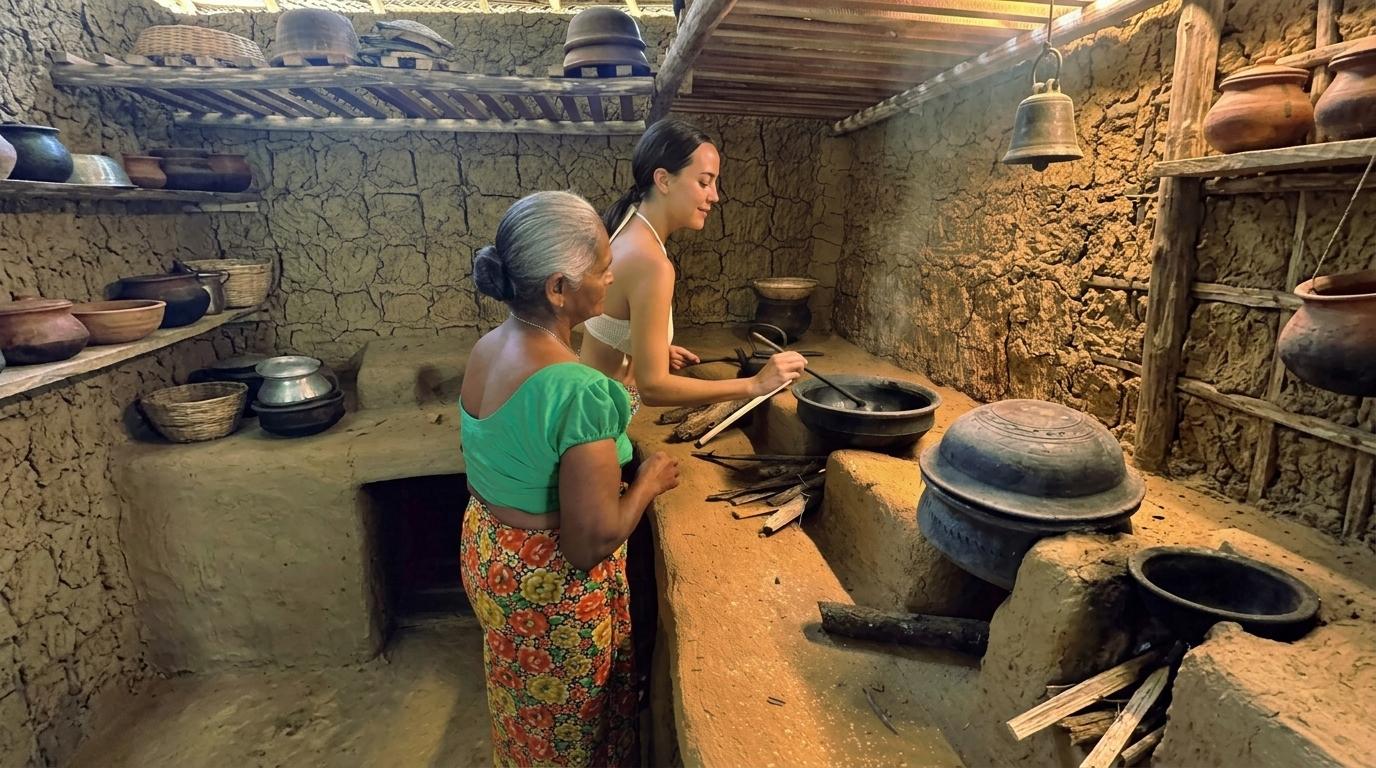
COOKING WITH A FAMILY HOST
A home setting can be intimate and memorable because recipes are often taught through habit rather than formal measurements.
That informality is part of the charm, but the host should still be paid fairly and not expected to provide an elaborate meal as unpaid 'hospitality.'
Conversation over the meal can be as valuable as the cooking itself.
COOKING WITH CHILDREN
Children can enjoy scraping coconut, mixing ingredients or shaping simple foods under supervision.
Keep them away from open flames, hot oil and sharp tools unless the activity is age-appropriate and directly supervised.
A shorter menu with more hands-on tasks is usually better than a long demonstration.
WHAT TO BRING
• Comfortable clothing suitable for a kitchen
• Closed or secure footwear if the kitchen requires it
• Hair tie if needed
• Any allergy or dietary information shared in advance
• Notebook or phone for recipe notes
• An appetite - the class should end with eating
RECIPES AND REPLICATING THE MEAL AT HOME
Ask for ingredient names in English and, where useful, Sinhala or Tamil.
Take note of which ingredients can be substituted abroad and which change the character significantly.
Exact household recipes may use instinct rather than grams and teaspoons. That is an opportunity to learn sensory cues: aroma, color, texture and taste.
A good cooking experience gives travelers enough understanding to recreate the meal, not merely a printed recipe card.
RESPONSIBLE FOOD TOURISM
Credit the cook. Pay hosts fairly. Buy ingredients locally where practical.
Avoid presenting women cooking in a home as an automatically available tourist resource.
Food culture survives through people and daily labor, and that work deserves the same respect as a chef in a formal restaurant.
FREQUENTLY ASKED QUESTIONS
What will I cook? Menus vary, but rice, curries, sambols, dhal, hoppers or other regional dishes may be included.
Is Sri Lankan food always very spicy? No. Heat levels vary widely, and a balanced meal includes different levels of spice and richness.
Can vegetarians join? Usually yes, but ingredients and cross-contact should be confirmed.
Can I visit a market first? Many strong experiences combine shopping or a garden visit with cooking.
Are cooking classes suitable for children? Yes, when tasks, tools and duration are adapted to the child's age.
Will I get recipes? This depends on the host, but Ceylon Velo should provide clear notes or recipes where possible.
FINAL THOUGHTS
A cooking class succeeds when the traveler can taste a curry later and understand something about how it was built.
The memory is not only the recipe. It is the sound of spices hitting hot oil, the smell of curry leaves, the texture of freshly scraped coconut and the way several dishes become one meal when eaten together.
At Ceylon Velo, traditional cooking should be hands-on, regionally honest and respectful of the people whose knowledge makes the experience possible.
Written By
Ceylon Velo
Lead Travel Curator at Ceylon Velo with a passion for uncovering the untold stories of the island.
Join the Journey
Subscribe to receive exclusive travel guides and island stories directly in your inbox.