
V
EXPLORE SRI LANKA
PLAN YOUR JOURNEY
CEYLON VELOSRI LANKA
Food & Culinary Experiences
Rice & Curry Experience: The Complete Guide
August 8, 2026 9 min read
BALANCE, CONTRAST AND THE LOGIC OF A SRI LANKAN MEAL
Ask ten Sri Lankan families what makes a perfect rice and curry meal and you may receive ten different answers.
That is exactly why the experience is worth having.
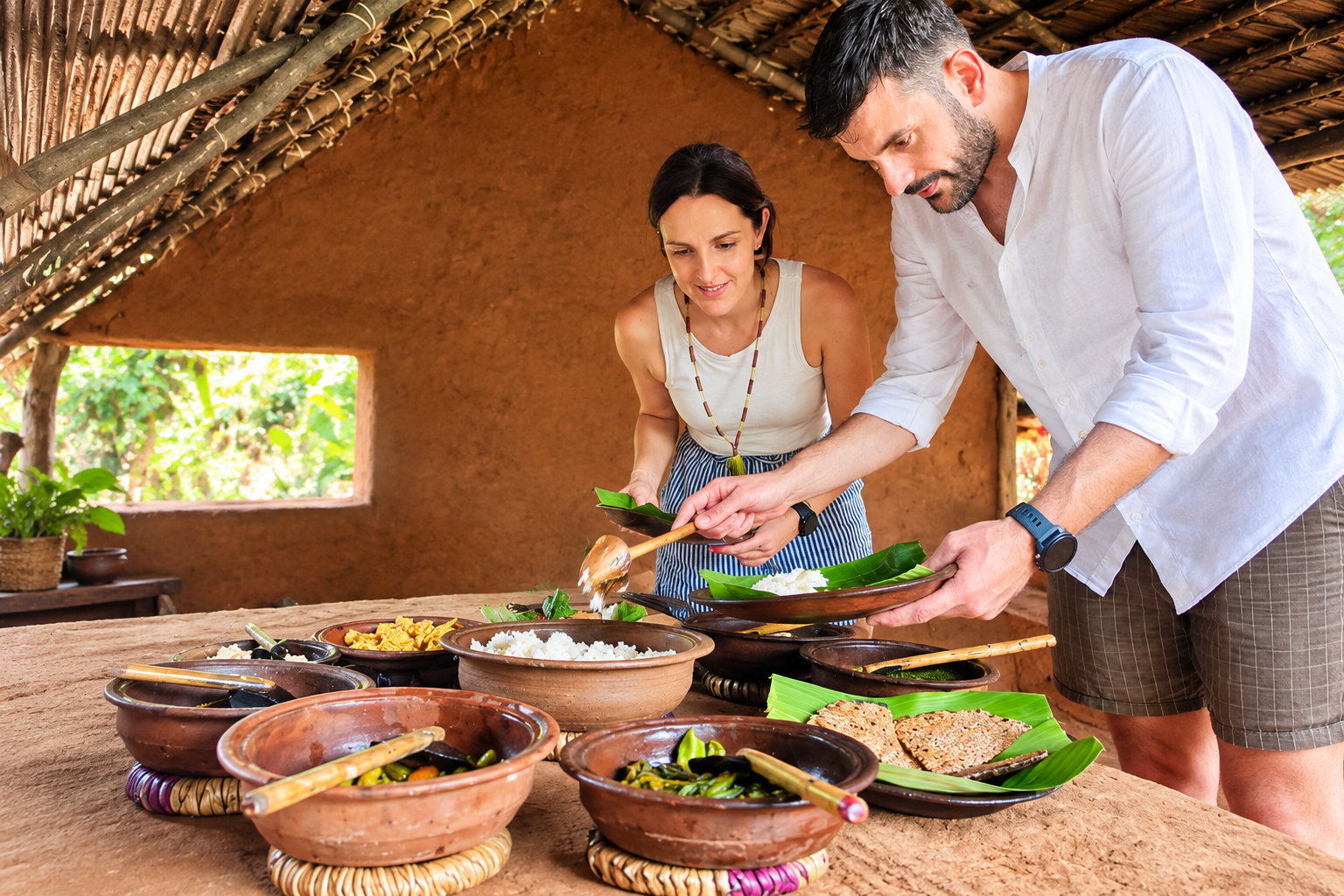
Rice and curry is not a single recipe. It is a flexible meal built around contrast: soft and crisp, mild and hot, creamy and sour, dry and saucy, familiar and surprising. The plate becomes a map of Sri Lankan home cooking.
RICE AND CURRY IS A MEAL SYSTEM
The phrase 'rice and curry' sounds singular, but the meal is usually plural. Rice is surrounded by several accompaniments, each with a different purpose.
A dhal curry may provide softness and comfort. A dry vegetable preparation can add texture. Coconut sambol brings freshness and heat. Pickle sharpens the plate. A fish, chicken, egg or jackfruit curry may provide depth.
The pleasure comes from combining them rather than tasting each dish in isolation.
THE RICE
Sri Lanka grows and eats many varieties of rice. White rice is common, while red rice and traditional local varieties can appear depending on the household, region and style of meal.
Rice should not be treated as a neutral filler. Its texture and aroma affect the entire plate, especially when paired with coconut-rich curries or sharp sambols.
DHAL: THE QUIET ESSENTIAL
Lentil curry is one of the most comforting parts of many Sri Lankan meals.
Recipes differ, but dhal often combines red lentils with spices and coconut milk or another liquid base. Some versions are mild and creamy, while others are finished with a tempering of onion, chilli, curry leaves or spices.
For travelers new to Sri Lankan food, dhal often becomes the bridge between the familiar and the more intense dishes on the plate.
VEGETABLE CURRIES
Vegetables are not side notes in Sri Lankan cooking. Pumpkin, beans, beetroot, brinjal, okra, breadfruit, jackfruit, potato, gourds and leafy greens can all become substantial dishes.
Preparation changes character completely. One vegetable may be cooked softly in coconut milk, while another is made dry with spices, onion and grated coconut.
This variety makes rice and curry particularly rewarding for vegetarian travelers.
MALLUNG AND GREENS
Mallung is a category of finely chopped greens mixed or cooked with coconut and seasonings.
It adds freshness, texture and color to a plate dominated by cooked curries.
Different households use different leaves, so the exact flavor can change with season and region.
POL SAMBOL
Pol sambol is one of the most recognizable Sri Lankan accompaniments, typically built around freshly grated coconut, chilli, onion and lime, with household variations.
It brings brightness, texture and heat.
A small amount can transform a mild spoonful of rice and dhal, demonstrating how Sri Lankan meals are designed around combination.
PICKLES, CHUTNEYS AND SHARP FLAVORS
A spoonful of pickle or another acidic condiment can cut through coconut-rich or oily dishes.
These stronger elements are usually eaten in small quantities. Their job is contrast, not volume.
Travelers often discover that the smallest item on the plate can have the biggest impact.
FISH, CHICKEN AND MEAT CURRIES
Coastal regions often feature fish prominently, while chicken is common across the island. Meat dishes vary by community, region and household.
Cooking methods range from lighter coconut-based curries to darker preparations using roasted spices.
A responsible food experience should identify the protein clearly and never assume travelers recognize unfamiliar cuts or seafood.
JACKFRUIT AND PLANT-BASED CENTERPIECES
Young jackfruit can become a savory curry with a texture that makes it a satisfying centerpiece.
Other plant-based dishes can create equally substantial meals, making it possible to design a fully vegetarian or vegan rice-and-curry spread without making the experience feel like a reduced version of the standard menu.
COCONUT IN MULTIPLE FORMS
Coconut is one of the threads connecting many Sri Lankan dishes.
It can appear as thick or thin milk in curry, freshly grated in sambol or mallung, or as an ingredient in sweets and accompaniments.
A guided tasting becomes much more interesting when the host points out how the same ingredient behaves differently across the plate.
ROASTED AND UNROASTED SPICE PROFILES
Not every curry uses the same spice mixture. Some dishes rely on lighter, unroasted spice combinations, while darker meat or fish curries may use roasted curry powder for deeper flavor.
The difference is not simply 'more spice.' Roasting changes aroma and character.
REGIONAL VARIATION
Rice and curry changes across Sri Lanka.
Coastal meals may emphasize seafood. Northern cooking has its own distinctive traditions. Up-country, Muslim, Burgher, Tamil and Sinhalese food cultures each contribute different preparations and flavor profiles.
Even neighboring households may cook the same vegetable differently.
The correct travel lesson is not to memorize one national recipe, but to understand that Sri Lankan food has many local voices.
HOW TO EAT THE MEAL
Traditionally, many Sri Lankans eat rice and curry with the right hand, mixing small portions of curry into the rice with the fingertips before forming a bite.
Visitors may try this after washing their hands thoroughly, but it should never be forced as a performance.
Using cutlery is completely acceptable.
What matters more is tasting combinations rather than separating every dish.
HOW TO BUILD A BITE
Start with rice and one mild curry. Then add a little dhal. Introduce sambol or pickle gradually. Compare the change.
This method turns the meal into a tasting exercise.
Overloading the first bite with every dish makes it harder to understand the role of each element.
SPICE LEVEL
Sri Lankan food can be spicy, but not every dish is designed to be aggressively hot.
Heat usually comes from chilli, while aroma comes from a much wider set of ingredients.
A good host can moderate chilli while preserving the broader flavor structure, especially for families or first-time visitors.
VEGETARIAN AND VEGAN TRAVELERS
Rice and curry can be one of the easiest Sri Lankan meals to adapt for vegetarian travelers because vegetables, dhal, greens, coconut and jackfruit are already central to the cuisine.
Vegan travelers should still confirm ingredients because some apparently vegetable-based preparations may contain dried fish, Maldive fish, dairy, egg or other animal products.
A premium operator should confirm the menu rather than guessing.
ALLERGIES AND FOOD SAFETY
Travelers with allergies should communicate them before the meal is prepared.
Coconut, fish, shellfish, nuts, sesame, egg, dairy and other allergens can appear depending on the kitchen.
For severe allergies, a controlled professional kitchen may be more appropriate than an informal home meal because cross-contact can be difficult to guarantee.
HOME MEAL VS RESTAURANT
A home-style meal can provide stronger cultural context and conversation.
A carefully chosen restaurant may offer better infrastructure, easier allergy management and a wider menu.
Neither is automatically more authentic. The right choice depends on the traveler, the host and the quality of interpretation.
MARKET-TO-TABLE OPTION
A market visit before the meal can introduce unfamiliar vegetables, fresh coconut, chilli, greens, fish and spices.
This makes the final plate easier to understand because travelers have already seen ingredients in their raw form.
A short market stop is often more valuable than an overly long shopping tour.
WHAT TO ASK THE HOST
• Which dish is most typical of this region or household?
• Which curries are mild and which are hot?
• Which dishes use coconut milk?
• Which spice mix is roasted?
• What should I combine with the sambol or pickle?
• Which dish would you make for an ordinary family lunch rather than a special occasion?
FREQUENTLY ASKED QUESTIONS
Is rice and curry always spicy? No. A full spread usually contains a range of heat levels.
Is it vegetarian-friendly? Very often, yes, but ingredients should be confirmed rather than assumed.
Do I have to eat with my hand? No. You may try it if you wish, but cutlery is completely acceptable.
How many curries are served? There is no fixed number. The meal changes by household, budget, region and occasion.
Can children enjoy it? Yes. Mild dishes such as rice, dhal and selected vegetable curries can make a good introduction.
What makes a premium experience? A thoughtful host, clean preparation, a balanced menu, cultural explanation and enough time to taste rather than rush.
FINAL THOUGHTS
A good rice-and-curry experience changes the way you look at the plate.
What first seemed like many separate bowls becomes a carefully balanced system of contrast.
At Ceylon Velo, the goal is to help travelers understand that balance - not simply to serve a large lunch.
Written By
Ceylon Velo
Lead Travel Curator at Ceylon Velo with a passion for uncovering the untold stories of the island.
Join the Journey
Subscribe to receive exclusive travel guides and island stories directly in your inbox.