
V
EXPLORE SRI LANKA
PLAN YOUR JOURNEY
CEYLON VELOSRI LANKA
Heritage & Ancient Wonders
Polonnaruwa Ancient City: The Complete Guide
July 22, 2026 15 min read
SRI LANKA'S GREAT MEDIEVAL CAPITAL
Polonnaruwa tells the story of a kingdom rebuilding itself.
After Anuradhapura ceased to be Sri Lanka's political center, power shifted to Polonnaruwa. What survives today is a remarkable medieval landscape of royal palaces, Buddhist monasteries, Hindu shrines, monumental sculpture, reservoirs and carefully planned urban spaces.
UNESCO identifies Polonnaruwa as Sri Lanka's second capital after the destruction of Anuradhapura in 993. The World Heritage property preserves Brahmanic monuments associated with the Cholas alongside the monumental garden-city created under King Parakramabahu I in the 12th century. It was inscribed on the World Heritage List in 1982.
WHY POLONNARUWA MATTERS
Polonnaruwa is important because several cultural and political worlds can be read within one ancient city. Chola rule left Hindu religious architecture. Later Sinhalese kings developed royal and Buddhist monuments on an extraordinary scale. The result is not a single-period ruin but a landscape showing change, adaptation and cultural interaction.
Compared with Anuradhapura, many of Polonnaruwa's best-known monuments are experienced within a more concentrated archaeological route. This makes the city particularly rewarding for travelers who want to understand architecture and sculpture without losing the larger story of kingship, religion and water management.
FROM ANURADHAPURA TO POLONNARUWA
The shift of the capital followed a period of conflict and South Indian Chola power. UNESCO's description marks 993 as the turning point after the destruction of Anuradhapura. Polonnaruwa subsequently developed as the island's major medieval political center.
The Chola presence is still visible in Brahmanic monuments, particularly Shiva shrines. Later rulers transformed the city again, creating Buddhist monuments, palaces and hydraulic works that became defining features of the Polonnaruwa period.
KING VIJAYABAHU I AND THE RESTORATION OF SINHALESE RULE
King Vijayabahu I is central to Polonnaruwa's political story. After defeating Chola power, he re-established Sinhalese rule and made Polonnaruwa the royal capital. His reign helped create the conditions for the major developments that followed in the 12th century.
For visitors, this historical transition explains why Buddhist and Hindu monuments coexist within the archaeological city. Polonnaruwa preserves evidence of both conquest and recovery rather than presenting a simple uninterrupted royal narrative.
THE AGE OF PARAKRAMABAHU I
Polonnaruwa reached one of its greatest periods under King Parakramabahu I in the 12th century.
UNESCO specifically identifies the monumental garden-city created during his reign as central to the site's World Heritage character.
His period is associated with ambitious construction, monastic development and major hydraulic works. Official Sri Lanka Tourism material highlights the enormous Parakrama Samudra reservoir and numerous monasteries, temples, palaces, bathing pools and Buddhist statues associated with the medieval city.
The scale of these works makes Polonnaruwa more than a collection of beautiful monuments. It represents a coordinated royal vision linking city, religion, agriculture and water.
PARAKRAMA SAMUDRA: THE SEA OF PARAKRAMA
Before or after exploring the ruins, spend time beside Parakrama Samudra. The huge artificial reservoir is one of the clearest reminders that ancient Sri Lankan power depended as much on water management as on palaces and temples.
Official Sri Lanka Tourism material describes the reservoir as a vast work associated with Parakramabahu and notes that it remains in use. UNESCO's recent reporting also recognizes the reservoir as an essential feature coexisting with the historic city's original layout.
The open water creates a powerful contrast with the brick and stone of the archaeological zone. It is particularly atmospheric when the light softens later in the day.
THE ROYAL PALACE COMPLEX
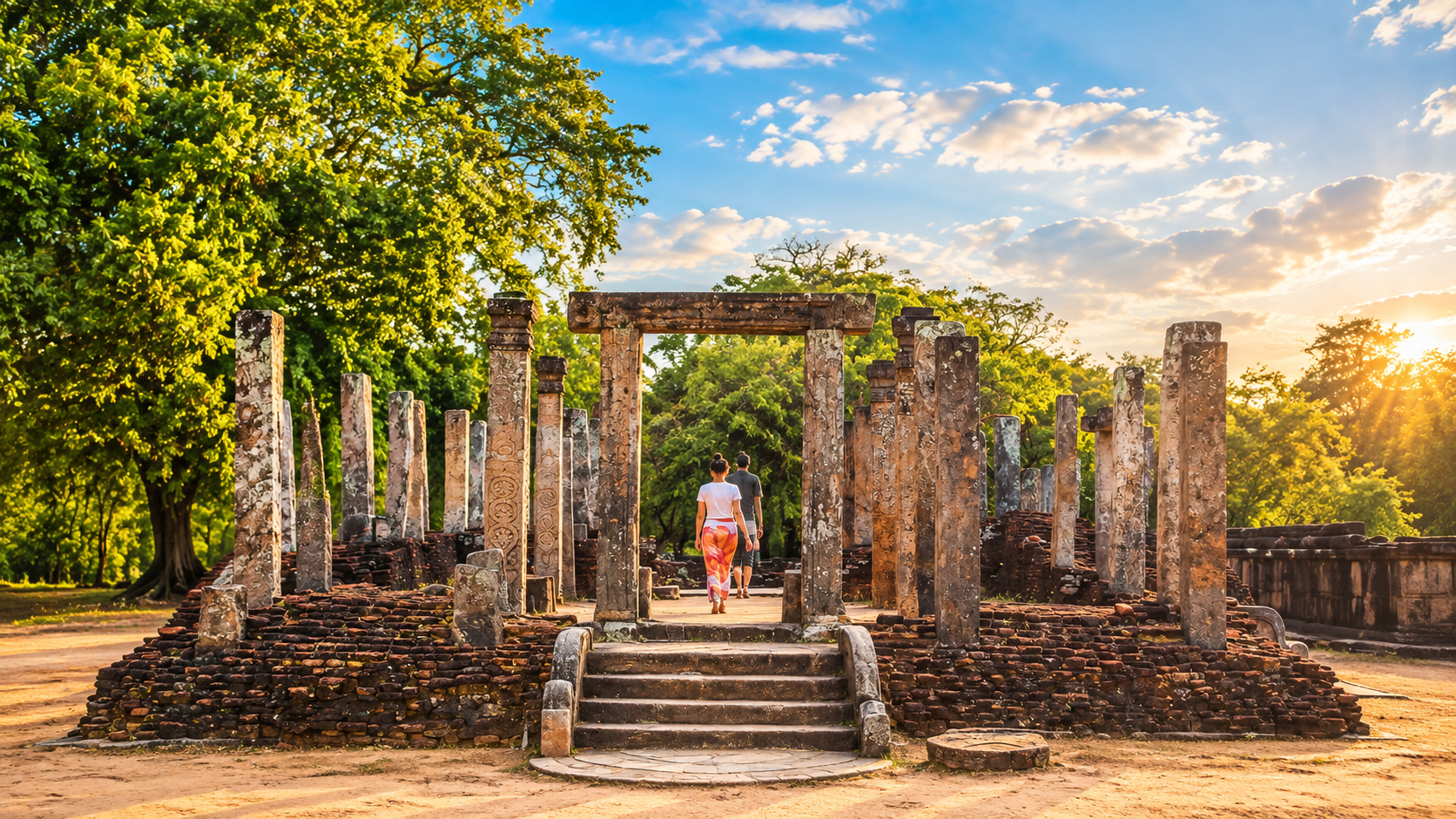
The palace area introduces the political heart of Polonnaruwa. The surviving brick walls hint at the scale of a royal residence that once contained multiple levels and rooms. Nearby structures associated with court life help visitors imagine a functioning capital rather than an isolated ceremonial complex.
The ruins require imagination. Instead of expecting intact interiors, look at wall thickness, foundations, stairways and the relationship between buildings. These fragments reveal how monumental royal architecture was organized.
THE AUDIENCE HALL
The Audience Hall is one of the palace area's most visually satisfying structures. Its raised stone platform, carved elements and approach communicate royal ceremony even without the original superstructure.
This is a good place to slow down and notice detail. Polonnaruwa's story is often most visible where architecture and sculpture meet: carved bases, steps, guard stones and animal motifs all contribute to the experience.
THE SACRED QUADRANGLE
The compact group of monuments commonly called the Sacred Quadrangle is one of Polonnaruwa's richest architectural areas. Several religious structures stand close together, allowing visitors to see different forms of medieval sacred architecture within a relatively small space.
The concentration makes this area especially useful for travelers trying to understand how relic worship, image houses and Buddhist ritual architecture developed during the Polonnaruwa period.
POLONNARUWA VATADAGE
The circular Vatadage is one of the ancient city's defining monuments. Its concentric design, stone stairways, guard stones and seated Buddha images create an elegant architectural composition.
A vatadage is associated with the protection and veneration of a sacred relic or stupa. At Polonnaruwa, the surviving stonework makes the building one of the best places to appreciate the precision and refinement of medieval Sri Lankan craftsmanship.
ATADAGE, HATADAGE AND THE TOOTH RELIC TRADITION
Polonnaruwa's sacred precinct also preserves structures connected with the tradition of housing the Buddha's Tooth Relic, a relic deeply linked with legitimate kingship in Sri Lanka.
UNESCO comparative material identifies the Atadage as an early Tooth Temple at Polonnaruwa. The presence of relic-related architecture helps explain why political and religious authority were so closely intertwined in the medieval capital.
GAL POTHA AND NISSANKA LATHA MANDAPAYA
The Sacred Quadrangle also rewards attention to monuments that can be overshadowed by the Vatadage.
Gal Potha, the massive stone inscription known as the 'Stone Book,' reflects the importance of royal inscriptions as political records. Nissanka Latha Mandapaya, associated with King Nissanka Malla, is distinguished by unusual stone columns shaped with an organic, lotus-stalk-like quality.
Together, these monuments reveal that Polonnaruwa's heritage is not only about size. Written record, ceremonial space and refined stone design are equally important.
SHIVA DEVALE AND THE CHOLA LAYER
The Hindu shrines of Polonnaruwa are essential to understanding the city's multicultural history. UNESCO emphasizes the Brahmanic monuments built by the Cholas as part of the World Heritage property's identity.
These shrines should not be treated as side notes to a Buddhist city. They are evidence of a period of South Indian political power and of the wider religious interactions that shaped medieval Sri Lanka.
RANKOTH VEHERA
Rankoth Vehera is among Polonnaruwa's major stupas. Its large brick form links the medieval capital visually with the older stupa-building traditions of Anuradhapura while belonging to a different historical period.
The surrounding open space helps communicate the monument's scale. As at other sacred sites, visitors should behave respectfully and follow local rules concerning footwear, dress and photography.
ALAHANA PIRIVENA: A GREAT MONASTIC UNIVERSITY
Official Sri Lanka Tourism material describes Alahana Pirivena as a huge 12th-century Buddhist monastic and educational complex constructed under Parakramabahu I, where large numbers of monks were educated.
The complex includes major monuments such as Lankatilaka, Kiri Vehera, the chapter house and remains associated with an ancient hospital, together with numerous monastic cells.
Exploring this area makes it easier to understand that medieval monasteries were complex institutions involving worship, education, residence, discipline and care - not simply individual temples.
LANKATILAKA IMAGE HOUSE
Lankatilaka is one of Polonnaruwa's most dramatic brick-built image houses. Its towering walls create a powerful sense of vertical scale even in ruin.
UNESCO material recognizes Polonnaruwa's vaulted brick image houses as significant examples of medieval architecture. Walking through the surviving structure gives a very different spatial experience from the open stupas and circular relic houses elsewhere in the city.
KIRI VEHERA
Kiri Vehera stands within the Alahana Pirivena area and is one of Polonnaruwa's important stupas. Its relatively well-preserved form provides another perspective on the Buddhist architectural landscape surrounding the great monastery.
It works particularly well as part of a sequence with Lankatilaka and Gal Vihara, allowing the visitor to move from stupa to monumental image house to rock-cut sculpture.
GAL VIHARA: MASTERPIECES CARVED FROM GRANITE
For many visitors, Gal Vihara is the artistic climax of Polonnaruwa.
Official Sri Lanka Tourism identifies the site with the Uttararama, built by Parakramabahu I in the 12th century. The sanctuary contains major Buddha images carved directly from the granite rock, including seated, standing and reclining figures, as well as a rock-cut cave shrine.
The workmanship is remarkable not simply because of the figures' scale but because the sculptors used the natural granite surface to create expressions of stillness and monumentality.
UNDERSTANDING THE GAL VIHARA IMAGES
The reclining image is associated with the Buddha's Parinirvana. The standing figure is particularly famous for its unusual crossed-arm posture and has generated scholarly interpretation. The seated image is framed by an elaborate carved setting, while the cave contains another seated image and traces of paintings.
Sri Lanka Tourism also notes an important inscription at the site containing monastic disciplinary rules associated with reforms under Parakramabahu I.
Because these remain sacred Buddha images, photography and behavior should be respectful. Avoid posing with your back directly toward the statues for casual photographs.
TIVANKA IMAGE HOUSE
Tivanka Image House is especially important for travelers interested in painting as well as architecture.
UNESCO comparative documentation highlights its surviving wall paintings illustrating Jataka narratives, the stories of the Buddha's previous lives.
The monument adds an important dimension to Polonnaruwa: the medieval capital was not only a center of architecture and sculpture but also of sophisticated painting traditions.
A CITY OF BUDDHISM AND HINDUISM
Polonnaruwa's mixture of Buddhist and Hindu monuments is one of its most important characteristics.
UNESCO documentation recognizes rituals and traditions connected with both religions as part of the property's cultural significance.
Rather than seeing these monuments as contradictions, view them as evidence of the political and cultural complexity of medieval Sri Lanka and its close connections with South India.
HOW LONG DO YOU NEED?
For most first-time visitors, half a day is a sensible minimum for the major highlights. A deeper visit can comfortably take most of a day, especially if you enjoy archaeology, sculpture or photography.
Trying to cover every named ruin usually reduces the experience. It is better to understand the palace area, Sacred Quadrangle, key monastic monuments and Gal Vihara properly than to rush through a much longer checklist.
GETTING AROUND POLONNARUWA
The archaeological city covers enough ground that transport matters. Cycling is popular because the terrain is generally manageable and a bicycle allows travelers to move at their own pace. Heat, fitness and road conditions should still be considered.
A private vehicle or tuk-tuk is more comfortable for families, travelers with limited time or anyone visiting during hotter conditions. Even with transport, significant walking within individual monument groups is part of the experience.
BEST TIME OF DAY
Early morning is excellent for cooler temperatures, softer light and a calmer start. Ancient brick and carved stone photograph beautifully before the strongest sun.
Late afternoon is another rewarding period, particularly around open landscapes and Parakrama Samudra.
Midday heat can make cycling and exposed walking tiring, so build in shade, water and rest.
WHAT TO WEAR AND BRING
• Light, breathable clothing suitable for tropical heat
• Clothing that covers shoulders and knees for sacred areas
• Comfortable walking shoes or sandals that are easy to remove
• Socks for hot sacred-site ground where permitted
• Drinking water and sun protection
• A hat for general outdoor exploration, removed where required
• A compact rain layer when showers are possible
• A camera or phone used respectfully around sacred images and worshippers
TEMPLE AND STATUE ETIQUETTE
Several monuments remain sacred. Remove footwear and hats where required, dress modestly and follow signs or instructions from site staff.
Buddha images deserve particular respect. Avoid climbing onto sacred structures or arranging photographs that treat religious statues as props. Give worshippers space and keep noise low in active devotional areas.
PHOTOGRAPHY GUIDE
Polonnaruwa offers a broad range of photographic subjects: monumental brick, detailed stone carving, symmetrical sacred architecture, rock-cut sculpture, forested ruins and open water.
Wide lenses work well in the palace and monastic landscapes, while longer focal lengths can isolate carvings and sculpture. Gal Vihara benefits from patient observation rather than rushed snapshots. Follow all photography restrictions, especially around sensitive paintings and sacred spaces.
Drone and professional-shoot requirements can differ from ordinary visitor photography and should be confirmed with the relevant authorities before arrival.
TICKETS AND VISITOR INFORMATION
Ticket prices, opening arrangements, access conditions and photography rules can change. Confirm current official information shortly before travel rather than relying on an old online figure.
A guide is not compulsory for enjoying Polonnaruwa, but good interpretation adds substantial value because monuments from different rulers, religions and functions can otherwise appear as disconnected ruins.
POLONNARUWA OR ANURADHAPURA?
The strongest answer is: both, if your itinerary allows.
Anuradhapura is older, larger and experienced strongly as a living pilgrimage landscape. Its enormous stupas, sacred Bodhi tree and ancient monasteries communicate the foundations of Sri Lankan Buddhist civilization.
Polonnaruwa is later and more concentrated. Royal architecture, Hindu shrines, refined Buddhist sculpture and medieval monastic complexes make its story distinct.
Together, the two capitals show continuity and transformation across many centuries of Sri Lankan history.
COMBINING POLONNARUWA WITH WILDLIFE
Polonnaruwa's location makes it possible to combine heritage with nearby wildlife landscapes, including Minneriya and Kaudulla areas depending on season and current wildlife conditions.
However, a safari should not simply be added to an already overloaded archaeological day. If both are planned, start early, prioritize the ancient-city highlights and leave enough time to travel comfortably to the wildlife area.
A SUGGESTED CEYLON VELO POLONNARUWA DAY
Early morning: Begin before the strongest heat, exploring the Royal Palace complex and Audience Hall.
Morning: Continue to the Sacred Quadrangle, allowing enough time for the Vatadage and surrounding monuments rather than treating them as quick photo stops.
Late morning: Move through selected stupas and the Alahana Pirivena complex, including Lankatilaka and Kiri Vehera.
Before lunch: Finish the principal archaeological route at Gal Vihara, where the sculpture deserves unhurried attention.
Afternoon: Rest over lunch. Depending on the wider itinerary, continue toward a nearby wildlife experience, visit another selected monument, or slow the day down beside Parakrama Samudra.
Evening: If staying locally, enjoy the softer landscape around the reservoir rather than adding another long transfer unnecessarily.
RESPONSIBLE TRAVEL
Polonnaruwa is a protected archaeological city and a sacred landscape. Stay on designated routes, do not climb ruins, never scratch or mark stone surfaces, and follow conservation barriers.
Carry waste away, avoid disturbing wildlife around forested ruins, and respect active religious practice.
Responsible travel here is simple: leave the archaeology untouched and allow sacred spaces to remain sacred.
FREQUENTLY ASKED QUESTIONS
Is Polonnaruwa worth visiting?
Yes. It is one of Sri Lanka's most important medieval archaeological landscapes and offers an exceptional combination of royal ruins, Buddhist sculpture, Hindu architecture and ancient water engineering.
How long should I spend there?
Allow at least half a day for the main highlights. Travelers with a strong heritage interest may prefer most of a day.
Is Polonnaruwa a UNESCO World Heritage Site?
Yes. The Ancient City of Polonnaruwa was inscribed on the World Heritage List in 1982 under criteria (i), (iii) and (vi).
What should I not miss?
The Royal Palace area, Sacred Quadrangle and Vatadage, selected Alahana Pirivena monuments, Gal Vihara and the wider relationship with Parakrama Samudra form a strong first visit.
Can I cycle around Polonnaruwa?
Yes. Cycling is a popular way to explore, provided the heat, weather and your fitness are suitable.
Do I need a guide?
Not necessarily, but a knowledgeable guide can connect the Chola period, Sinhalese kings, Buddhist institutions, Hindu monuments and hydraulic landscape into a much clearer story.
Can I combine Polonnaruwa with a safari?
Yes, depending on season, travel time and wildlife conditions. The day should be designed carefully so neither experience feels rushed.
Is it similar to Anuradhapura?
Both are ancient capitals, but their periods, atmosphere and monuments differ considerably. They complement rather than duplicate each other.
FINAL THOUGHTS: A MEDIEVAL KINGDOM WRITTEN IN STONE AND WATER
Polonnaruwa becomes most memorable when its monuments stop feeling separate.
The palace represents royal authority. The Sacred Quadrangle reveals ritual architecture. The Shiva shrines preserve the Chola layer. Alahana Pirivena shows the scale of Buddhist monastic learning. Gal Vihara demonstrates the extraordinary confidence of medieval sculpture. Parakrama Samudra reminds you that none of this urban and religious life could be separated from control of water.
Together they form the landscape UNESCO recognized as one of Sri Lanka's great World Heritage cities.
Do not race from ruin to ruin. Notice how the city changes as you move through it. Look at the engineering as carefully as the statues, and the smaller carvings as carefully as the giant brick structures.
At Ceylon Velo, we shape Polonnaruwa as a connected story of kingship, belief, art and water - not simply a list of archaeological stops.
ONE ISLAND. ENDLESS EXPERIENCES.
Plan Your Polonnaruwa Journey
Let us connect Polonnaruwa naturally with Sigiriya, Pidurangala, Dambulla, Anuradhapura and the wildlife landscapes of Sri Lanka's Cultural Triangle.
Written By
Ceylon Velo
Lead Travel Curator at Ceylon Velo with a passion for uncovering the untold stories of the island.
Join the Journey
Subscribe to receive exclusive travel guides and island stories directly in your inbox.