
V
EXPLORE SRI LANKA
PLAN YOUR JOURNEY
CEYLON VELOSRI LANKA
Heritage & Ancient Wonders
Pidurangala Rock: The Complete Guide
August 7, 2026 12 min read
SIGIRIYA'S UNFORGETTABLE VIEWPOINT
Sigiriya is one of Sri Lanka's most recognizable landmarks. But one of the finest ways to understand its scale is to stand on another ancient rock and look across the plains toward it.
That rock is Pidurangala.
Located close to Sigiriya in Sri Lanka's Cultural Triangle, Pidurangala combines an active Buddhist temple, an archaeological monastic landscape, a short but genuine hike and a broad summit with a celebrated view toward Lion Rock. It is especially popular around sunrise, yet reducing Pidurangala to a sunrise photo spot misses much of what makes the place meaningful.
Its history reaches back to the early centuries BCE. Official Sri Lanka Tourism information states that Pidurangala was used as a monastery from ancient times and became a prominent Buddhist monastic center during the reign of King Kassapa. Archaeological features include a stupa, chapter house, Bodhigaraya, preaching hall, image house, caves and the reclining Buddha image.
WHY PIDURANGALA DESERVES ITS OWN PLACE ON YOUR ITINERARY
Pidurangala is often discussed only in comparison with Sigiriya. The comparison is useful, but the two experiences are fundamentally different.
Sigiriya is a monumental royal and archaeological experience, with formal gardens, paintings, inscriptions, the Lion Gate and palace remains. Pidurangala feels less engineered and more natural. Its path passes through a living temple and old monastic setting before becoming a rocky climb. The reward is not a palace at the summit, but space, landscape and perspective.
For travelers who enjoy hiking, photography or places where history and nature overlap, it is one of the Cultural Triangle's most satisfying short adventures.
A HISTORY OLDER THAN SIGIRIYA'S ROYAL CAPITAL
Pidurangala's story did not begin with King Kassapa. Sri Lanka Tourism dates the site's monastic history to approximately the first and second centuries BCE, showing that Buddhist religious activity here predates the fifth-century royal transformation of nearby Sigiriya by several centuries.
During Kassapa's reign, Pidurangala became particularly prominent. Official tourism material associates the site with a monastery believed to have been known as Uppalavanna Kashyapa Giri Viharaya. The broader Sigiriya landscape therefore contained both royal and religious spaces, rather than two unrelated rocks standing beside one another.
That context changes the hike. The caves and ruins along the route are not decorative additions to a modern viewpoint trail; they are evidence of a long-lived sacred landscape.
THE MONASTERY AND PANCHAVASA TRADITION
Official Sri Lanka Tourism material describes Pidurangala as a panchavasa temple complex. In the traditional arrangement, principal ritual and monastic buildings formed an organized religious center. At Pidurangala, identified remains include an ancient stupa, chapter house, image house, Bodhigara, preaching hall and associated monastic features.
Drip-ledged caves also belong to this archaeological landscape. Such caves are strongly associated with early Buddhist monastic life in Sri Lanka, where natural rock shelters were adapted for religious use.
Travelers do not need to be archaeology specialists to appreciate this layer of Pidurangala. Simply recognizing that the trail crosses an ancient monastery makes the ascent much richer.
STARTING THE HIKE: PIDURANGALA RAJAMAHA VIHARAYA
The ascent begins through Pidurangala Rajamaha Viharaya, an active Buddhist temple. This matters because the first part of the experience is a sacred place rather than merely a trailhead.
Dress respectfully through the temple area. Shoulders and knees should be covered where required, footwear may need to be removed in designated sacred spaces, and visitors should follow instructions from temple staff. A lightweight scarf or shoulder covering is useful for travelers dressed primarily for hiking.
Move quietly and remember that local worshippers may be visiting for reasons entirely unrelated to tourism.
THE LOWER TRAIL
After the temple, the route begins climbing through vegetation and rock. Compared with Sigiriya's extensive engineered stair systems, Pidurangala feels more like a conventional short hike. Steps and rougher surfaces alternate as the trail gains height.
The shade of the lower route can make the first part comfortable in the morning, but humidity and heat still matter. A steady pace is better than trying to reach the top as quickly as possible.
THE RECLINING BUDDHA
One of the most distinctive historical features on the upper trail is the cave associated with a reclining Buddha image. Sri Lanka Tourism specifically identifies the recumbent Buddha cave among Pidurangala's archaeological remains.
It is worth pausing here rather than treating it as another marker on the way to the viewpoint. The setting reconnects the modern hike with the religious history that shaped the rock long before social media made its summit famous.
THE FINAL BOULDER SCRAMBLE
Near the summit, the character of the route changes noticeably. The path meets a cluster of large boulders and the final section requires scrambling rather than ordinary walking.
For many active travelers this section is short and enjoyable, but it should not be underestimated. You may need to use your hands, step across uneven rock and maneuver through gaps between boulders. It can feel considerably harder when wet, in darkness or while carrying a large bag.
Good shoes with grip are strongly recommended. Keep both hands available where possible, move one person at a time through awkward sections, and never rush because other hikers are waiting behind you.
REACHING THE SUMMIT
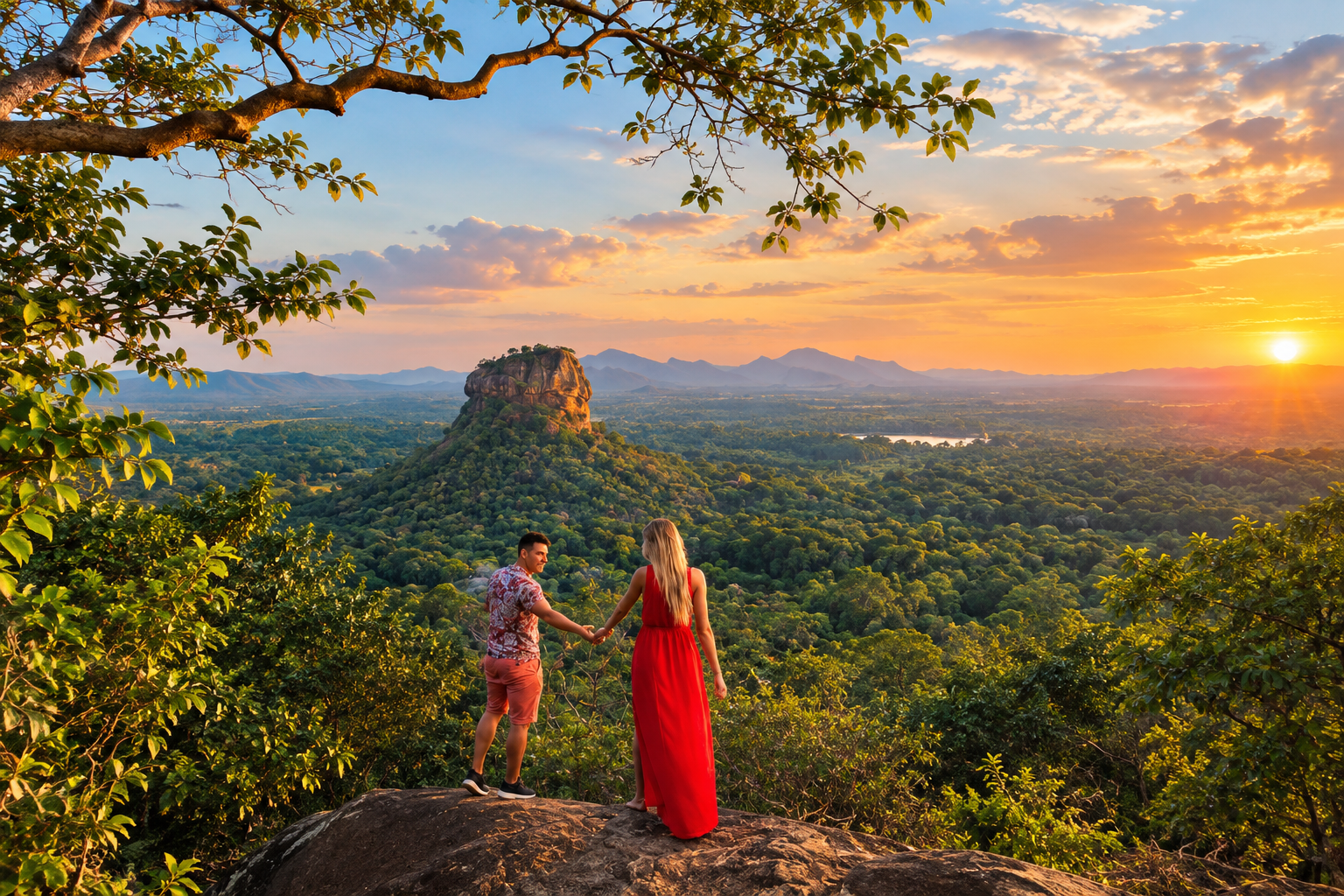
The reward arrives suddenly. After the confined boulder section, the landscape opens into a broad exposed rock plateau.
Sigiriya stands across the plains, separated enough from Pidurangala for its distinctive shape to be appreciated as part of the wider landscape. Official Sri Lanka Tourism itinerary material identifies Pidurangala as a major viewing point for Sigiriya and notes the broad views available from the summit.
The panorama extends beyond Lion Rock. Forest, reservoirs, farmland and distant hills fill the horizon, giving a strong sense of the scale of Sri Lanka's Cultural Triangle.
Walk beyond the first crowded viewpoint if conditions are safe. Different parts of the summit reveal different compositions and quieter places to sit.
SUNRISE AT PIDURANGALA
Sunrise is the experience most closely associated with Pidurangala today. The appeal is easy to understand: darkness gradually gives way to color, the plains become visible below, and Sigiriya emerges as a silhouette before the morning light strengthens.
But a sunrise ascent requires more preparation than a normal daylight hike. You will be navigating rough ground and the final boulders before full daylight. Carry a reliable headlamp or torch, keep your hands free, and allow more time than you would during the day.
Sunrise conditions are never guaranteed. Cloud, mist or rain may obscure the horizon. Treat clear color as a bonus rather than the only reason for climbing; the landscape remains impressive after sunrise.
EARLY MORNING WITHOUT THE PRE-DAWN START
Travelers who dislike hiking in darkness should not feel that they are missing Pidurangala. An early-morning daylight climb is often an excellent choice.
You gain cooler temperatures, easier navigation and good photographic light without negotiating the trail in darkness. For families, less confident hikers or anyone uncomfortable with the boulder section, this can be the better experience.
SUNSET AND LATE AFTERNOON
Late afternoon can produce warm light across the landscape and can be beautiful for photography. The key concern is the descent.
Do not remain on the summit so late that you are forced to negotiate the boulders and rough trail without adequate light. If planning around sunset, carry a proper light even when you expect to descend before darkness.
HOW DIFFICULT IS PIDURANGALA?
Pidurangala is a short hike, but 'short' does not mean effortless. The main challenges are uneven surfaces, heat, the final scramble and, for sunrise hikers, darkness.
Many active travelers can complete the route comfortably, but people with limited mobility, balance difficulties or a strong discomfort with scrambling should assess the final section carefully. Conditions after rain can change the difficulty substantially.
A useful planning range for the complete experience is roughly 1.5-2.5 hours, including time at the summit. Fitness, crowds, weather, photography stops and trail conditions can make the visit shorter or longer.
WHAT TO BRING
• Walking or hiking shoes with dependable grip
• Drinking water
• A headlamp or reliable torch for pre-dawn or late descents
• Sun protection for the exposed summit
• A light rain layer when showers are possible
• A small scarf or cover for respectful temple entry
• A compact bag that leaves your hands free for the scramble
• A charged phone or camera, without carrying unnecessary equipment
PHOTOGRAPHY AT PIDURANGALA
The classic composition places Sigiriya beyond the foreground rock and forest. A wide lens can emphasize the entire landscape, while a moderate telephoto perspective can make Sigiriya appear more dominant within the frame.
Sunrise photographers should arrive with equipment already organized; searching through a large bag in darkness is inconvenient and can obstruct others. Once the sun is up, explore the plateau instead of shooting only from the first viewpoint.
Photography should never compromise safety. Avoid standing close to exposed edges for a more dramatic image, and respect restrictions in temple and sacred areas.
WILDLIFE, WEATHER AND TRAIL AWARENESS
Pidurangala sits within a tropical landscape, so visitors should expect insects, changing weather and occasional wildlife. Do not feed animals or leave food exposed. Keep a respectful distance from any wildlife encountered.
Rock surfaces can become dangerously slippery during rain. Thunderstorms are another reason to avoid remaining on an exposed summit. If conditions deteriorate, the view is not worth taking unnecessary risk.
PIDURANGALA OR SIGIRIYA: WHICH SHOULD YOU CHOOSE?
Choose Sigiriya if your priority is Sri Lanka's major archaeological experience: royal history, formal water gardens, frescoes, the Mirror Wall, Lion Gate and summit palace remains.
Choose Pidurangala if your priority is a shorter natural hike, an adventurous scramble and the famous external view of Sigiriya.
Choose both if time, weather and fitness allow. They complement each other exceptionally well. Sigiriya explains the ancient royal city from within; Pidurangala places that city back into its surrounding landscape.
CAN YOU DO BOTH IN ONE DAY?
Yes, many active travelers can, but timing matters. Two climbs in tropical heat can be tiring, so avoid treating the day as a race.
One strong plan is Pidurangala around sunrise or early morning, followed by breakfast and a proper rest before visiting Sigiriya. Another is Sigiriya early in the morning and Pidurangala later when conditions are comfortable. Weather, site hours and individual fitness should determine the final sequence.
Ceylon Velo would plan this around the traveler rather than forcing everyone into the same schedule.
WHAT TO SEE NEARBY
Sigiriya Rock Fortress - The essential companion experience, offering the royal and archaeological story that Pidurangala overlooks.
Dambulla Cave Temple - A major Buddhist heritage site that adds another layer of sacred art and history to a Cultural Triangle journey.
Polonnaruwa - A later royal capital with extensive ruins, monumental Buddhist sculpture and ancient urban planning.
Anuradhapura - Sri Lanka's great ancient sacred city, ideal for travelers wanting a deeper heritage itinerary.
Pidurangala Museum - Sri Lanka's Department of Archaeology lists a site museum at Pidurangala displaying antiquities from the archaeological site and photographs; it opened to the public in 2008.
A SUGGESTED CEYLON VELO EXPERIENCE
Before dawn: Depart with water, proper footwear and a headlamp if choosing sunrise.
Ascent: Enter respectfully through the temple, follow the historic trail and pause at the monastic remains and reclining Buddha.
Summit: Complete the boulder scramble carefully, find a safe position and allow the landscape to unfold without rushing immediately back down.
After descent: Return for breakfast and rest. If visiting Sigiriya the same day, allow enough recovery time before beginning the longer archaeological visit.
Later: Continue to Dambulla or another Cultural Triangle site only if the schedule remains comfortable. A good journey should feel full, not overloaded.
RESPONSIBLE TRAVEL AT A SACRED LANDSCAPE
Pidurangala is simultaneously a hiking destination, archaeological site and living Buddhist temple. That combination demands respectful behavior.
Dress appropriately at the temple, follow instructions about footwear and photography, keep noise low around worship areas, do not climb on archaeological remains, and carry all rubbish away.
On the summit, avoid risky poses near edges and do not damage or mark the rock. The goal is to leave the experience exactly as you found it.
FREQUENTLY ASKED QUESTIONS
Is Pidurangala worth visiting if I already climbed Sigiriya?
Yes. The experiences are very different. Pidurangala provides a natural hike and an external view that helps you appreciate Sigiriya's position within the landscape.
Is Pidurangala easier than Sigiriya?
It is generally a shorter experience, but the final boulder scramble is less structured than Sigiriya's stairs. 'Easier' depends on whether you are more comfortable with stairs or scrambling.
How long does the hike take?
Plan roughly 1.5-2.5 hours for the full experience, including summit time. Individual pace and conditions vary.
Do I need a guide?
The route is popular, but a knowledgeable guide can add historical context and can be particularly useful for travelers interested in the monastery rather than only the viewpoint.
Do I need a torch for sunrise?
Yes. A reliable headlamp or torch is an important safety item when climbing before daylight.
Can children climb Pidurangala?
Some families do the hike, but adults should judge each child's mobility and confidence carefully, especially at the final scramble and exposed summit.
Can I hike after rain?
Wet rock can be slippery, particularly around the boulders. Conditions should be assessed on the day rather than assuming the route will always be safe.
Is Pidurangala only for sunrise?
No. Early-morning daylight and late-afternoon visits can also be excellent. Sunrise is famous, not mandatory.
FINAL THOUGHTS: THE VIEW IS ONLY HALF THE STORY
Most travelers first hear about Pidurangala because of a photograph of Sigiriya. That view deserves its reputation, but the strongest experience begins before you reach it.
You enter through a Buddhist temple. You climb through a landscape used by monks for more than two millennia. You pass archaeological remains and a reclining Buddha. You negotiate a final natural obstacle of boulders. Only then does the summit open and reveal Sigiriya across the plains.
Seen that way, Pidurangala is not simply the cheaper or quieter alternative to a more famous attraction. It is a distinct place with its own history and character.
At Ceylon Velo, we would pair the two rocks without making them compete: Sigiriya for the ancient royal city, Pidurangala for the landscape that surrounds it.
ONE ISLAND. ENDLESS EXPERIENCES.
Plan Your Pidurangala Journey
Let us time Pidurangala around the light, weather and your preferred pace, then connect it naturally with Sigiriya, Dambulla and the wider Cultural Triangle.
Written By
Ceylon Velo
Lead Travel Curator at Ceylon Velo with a passion for uncovering the untold stories of the island.
Join the Journey
Subscribe to receive exclusive travel guides and island stories directly in your inbox.