
V
EXPLORE SRI LANKA
PLAN YOUR JOURNEY
CEYLON VELOSRI LANKA
Waterfalls & Nature
Diyaluma Falls: The Complete Guide
August 12, 2026 8 min read
UPPER LANDSCAPES, LOWER VIEWS AND RESPONSIBLE WATERFALL TRAVEL
Diyaluma Falls is the kind of place that changes character depending on where you meet it.
From the road below, it appears as a long white ribbon dropping from the highlands. From the upper landscape, the experience becomes more intimate: moving water, exposed rock, open valleys and a sense of height that demands respect.
Sri Lanka Tourism lists Diyaluma at approximately 171 meters and describes it as the country's third-largest waterfall, located near Koslanda along the Koslanda-Wellawaya road in Badulla District.
WHY DIYALUMA FEELS DIFFERENT
Many waterfalls are visited from a single viewing platform. Diyaluma can be experienced from different elevations, which changes the entire journey.
The lower view emphasizes scale. The upper approach emphasizes landscape, walking and proximity to the watercourse.
For Ceylon Velo, the strongest itinerary explains both perspectives rather than treating the upper falls only as a social-media swimming location.
THE LOWER VIEW
The lower view is the easiest way to understand the height of Diyaluma.
From around the Koslanda-Wellawaya road, travelers can appreciate the long vertical drop against the escarpment.
This is also a useful option for guests who do not want a hike or when upper access is unsuitable because of weather.
THE UPPER DIYALUMA EXPERIENCE
Upper Diyaluma is reached through local roads and walking routes that can vary in condition.
The landscape includes smaller cascades and rock shelves before the water reaches the major drop.
Routes are not equivalent to a formal paved attraction. Conditions can change, and visitors should expect uneven ground, sun exposure, mud or slippery rock.
WATERFALL SAFETY IS NOT OPTIONAL
Waterfalls create hazards that are easy to underestimate. Wet rock can become nearly frictionless. Water depth can change suddenly. Current strength may not be visible from the surface.
At exposed edges, a single slip can have severe consequences.
Ceylon Velo should never promote cliff-edge sitting, jumping, standing directly beside the drop, or entering fast water for photographs.
SWIMMING AND NATURAL POOLS
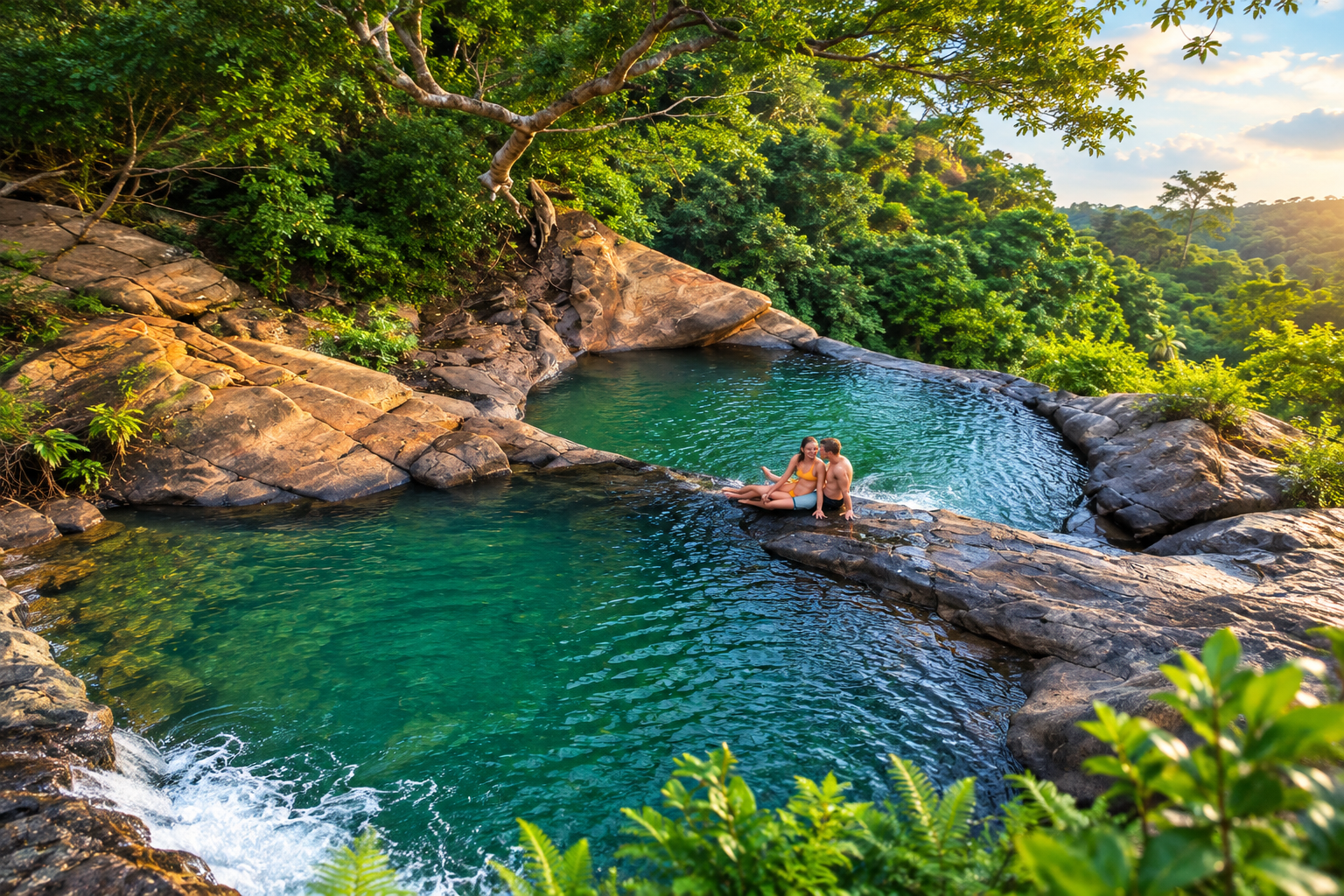
Online images often show people in pools around the upper falls, but photographs do not establish that a pool is safe on the day you visit.
Water flow depends on recent rain and upstream conditions.
Submerged rock, sudden depth, strong outflow and slippery access all matter.
The correct approach is condition-based: if a qualified local guide considers entry unsafe, guests stay out of the water.
There should be no promise of swimming in advance.
RAIN AND SEASONAL CHANGE
Diyaluma can be especially powerful during wetter periods, but greater flow also increases risk.
After rain, trails may become muddy and rock surfaces more dangerous. Visibility can also change quickly in the highlands.
A lower viewpoint can sometimes be the better experience on a high-flow day.
WHEN TO VISIT
Early starts can provide cooler walking conditions and more flexibility before afternoon weather changes.
There is no single perfect month for every traveler because waterfall volume, trail comfort and weather trade off against one another.
Ceylon Velo should check current local conditions rather than relying only on a generic seasonal rule.
WHAT TO WEAR
• Walking shoes with strong grip
• Light clothing suitable for warm sun and changing highland weather
• Rain layer when conditions are uncertain
• Hat and sun protection
• Drinking water
• No loose footwear for exposed or slippery sections
PHOTOGRAPHY
Diyaluma rewards wide-angle landscape photography, but the best image is never worth standing in an unstable position.
Use safer foregrounds, step back from exposed edges and allow the height of the landscape to create the drama.
Drones, where considered, must follow current Sri Lankan aviation, local and property rules.
WHO SHOULD CONSIDER THE LOWER VIEW ONLY
Travelers with limited mobility, poor balance, very young children, significant fear of heights or unsuitable footwear may enjoy Diyaluma more from lower viewpoints.
There is no loss of value in choosing the safer version of the experience.
A premium itinerary adapts the waterfall to the guest instead of forcing every traveler through the same route.
DIYALUMA WITH CHILDREN
Families should be conservative around upper falls.
Children need direct adult supervision at all times near water and exposed rock, and should not be allowed to run ahead on unprotected sections.
For younger families, the lower view or a limited guided walk may be the better choice.
COMBINING DIYALUMA WITH ELLA OR HAPUTALE
Diyaluma fits naturally into a hill-country route linking Ella, Haputale, Koslanda and surrounding tea landscapes.
It works particularly well on a private road itinerary because the journey can be adjusted for weather and walking ability.
A waterfall stop should not be scheduled so tightly that guests feel pressured to hurry on slippery terrain.
RESPONSIBLE NATURE TRAVEL
Carry out all rubbish and avoid leaving food packaging, bottles or tissues near the falls.
Do not use soap or toiletries in natural water.
Stay on established local paths where possible and avoid damaging vegetation to create shortcuts or photo positions.
LOCAL GUIDES
A knowledgeable local guide adds value beyond navigation.
The guide can assess recent rain, suggest the most appropriate route, identify unstable or exposed sections and help prevent visitors from following unsafe shortcuts copied from online videos.
For Ceylon Velo, local guiding should be treated as a safety and interpretation service, not an optional extra on the most exposed routes.
FREQUENTLY ASKED QUESTIONS
How high is Diyaluma Falls? Sri Lanka Tourism lists it at about 171 meters.
Where is it? Near Koslanda in Badulla District, along the Koslanda-Wellawaya road area.
Can I visit without hiking? Yes. The lower view provides a strong sense of the waterfall's scale.
Can I swim at Upper Diyaluma? Never assume it is safe. Entry should depend on current water, weather and local guidance, and may be inappropriate altogether.
Do I need a guide? For upper routes, a reliable local guide is strongly recommended.
Is it suitable for children? The lower view is easier. Upper sections require conservative judgment and close supervision.
FINAL THOUGHTS
Diyaluma is at its best when travelers respect both sides of the experience: beauty and exposure.
The waterfall does not need risky photographs or cliff-edge swimming to be extraordinary.
At Ceylon Velo, the goal is to show guests the scale of Diyaluma, the openness of the hill-country landscape and the power of moving water - while making safety the non-negotiable part of the plan.
Written By
Ceylon Velo
Lead Travel Curator at Ceylon Velo with a passion for uncovering the untold stories of the island.
Join the Journey
Subscribe to receive exclusive travel guides and island stories directly in your inbox.