
V
EXPLORE SRI LANKA
PLAN YOUR JOURNEY
CEYLON VELOSRI LANKA
Waterfalls & Nature
Bambarakanda Falls: The Complete Guide
June 25, 2026 8 min read
A 263-METRE WATERFALL JOURNEY NEAR KALUPAHANA
Bambarakanda Falls has a simple distinction that immediately gives it scale: it is Sri Lanka's tallest waterfall.
Sri Lanka Tourism lists the drop at 263 meters and places the falls near Kalupahana in Badulla District, around five kilometers from the A4 Highway.
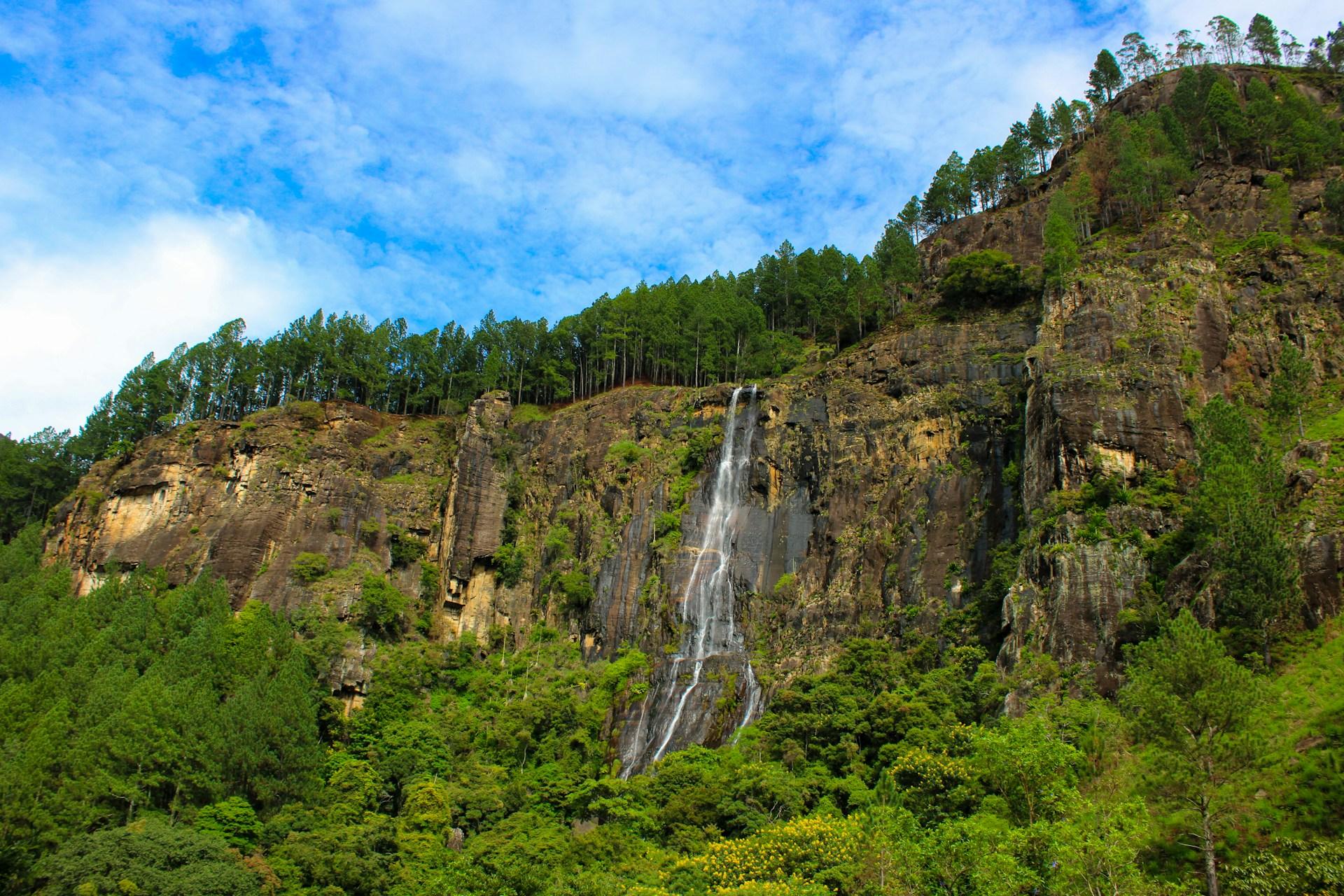
The waterfall descends in a relatively narrow line from the high escarpment into a forested landscape, making the experience feel more vertical than massive.
WHY BAMBARAKANDA IS SPECIAL
Height is the obvious reason to visit, but the setting matters just as much. The falls sit within a highland landscape of forest, slopes and quieter local roads.
The journey feels different from waterfalls that can be viewed directly from a major highway.
THE 263-METRE DROP
Sri Lanka Tourism identifies Bambarakanda as the tallest waterfall in the country at 263 meters.
Because the flow is relatively narrow, travelers sometimes underestimate the scale in photographs. Seeing surrounding trees and rock faces beside the cascade helps reveal its true height.
LOCATION AND APPROACH
Bambarakanda is associated with Kalupahana in Badulla District and lies off the A4 corridor.
Sri Lanka Tourism notes that the access road can be narrow, wet and potholed and recommends a capable vehicle for difficult conditions.
Road quality can change, so current local information matters more than an old travel blog or map screenshot.
THE FINAL WALK
The final approach involves walking rather than simply stepping out at a formal viewing deck. Expect uneven surfaces and natural terrain.
After rain, mud and slippery rock can make the experience slower, which should be treated as part of the day rather than a scheduling problem.
FOREST AND LANDSCAPE
Sri Lanka Tourism describes the falls as being found in a pine-forest setting.
The mixture of tall trees, mountain air and the narrow white cascade creates a distinctive atmosphere.
Visitors should avoid leaving marked or commonly used paths simply to obtain a different photograph.
WATERFALL SAFETY
Standing near the base of a tall waterfall can create a false sense of security because the major cliff is above rather than beside you.
Falling rock, slippery ground, strong runoff and changing water levels can still create risk.
Do not climb wet rock faces, enter forceful water or stand under unstable overhangs.
AFTER RAIN
Rain can make Bambarakanda visually stronger while making access more difficult.
The road may deteriorate, footpaths may become muddy and water can move with much greater force.
Ceylon Velo should assess both road and trail conditions before committing guests to the full approach.
BEST TIME OF DAY
An earlier start gives more time to deal with road delays, walking pace and changing mountain weather.
Light conditions also vary with cloud and mist, which can make the falls appear and disappear against the escarpment.
There is value in allowing the landscape to set the pace.
WHAT TO WEAR AND CARRY
• Walking shoes with reliable grip
• Light rain layer
• Drinking water
• Sun protection
• Small daypack
• No loose sandals for muddy or slippery access
• A change of socks in wet weather can be useful
PHOTOGRAPHY
Bambarakanda is ideal for vertical compositions because the height is the subject.
Include trees, people at a safe distance or sections of the escarpment to show scale.
Do not move onto unstable rock or into the stream simply to remove foreground elements from a photograph.
WHO WILL ENJOY IT MOST
Travelers who enjoy the journey to a natural place - not only the attraction itself - tend to appreciate Bambarakanda most.
It suits active couples, photographers, hikers and guests who enjoy quieter parts of the hill country.
Travelers seeking step-free access or a highly developed visitor site may prefer another waterfall.
FAMILIES AND ACCESSIBILITY
The suitability for children depends on age, weather and current access conditions.
Young children need close supervision on uneven ground, and families should be willing to turn back if the path becomes slippery.
This is not a place where completing the route should matter more than comfort or safety.
COMBINING BAMBARAKANDA WITH THE HILL COUNTRY
Bambarakanda can fit naturally into routes around Haputale, Kalupahana and the southern highlands.
It can also complement a tea-country or scenic-road day.
Because access can take longer than a map suggests, avoid pairing it with too many fixed-time attractions.
RESPONSIBLE TRAVEL
Carry all waste out with you and avoid plastic or food litter near the stream.
Do not remove plants, carve trees or create unofficial trails through forest.
Keep music low or off so the waterfall and forest remain the dominant experience.
WHY CURRENT CONDITIONS MATTER
Natural attractions are dynamic. A road described as difficult one month may improve, while heavy rain can damage it again.
Waterfall volume also changes.
Ceylon Velo should confirm recent conditions with local contacts rather than publishing rigid promises about drive time, road type or water level.
FREQUENTLY ASKED QUESTIONS
How high is Bambarakanda Falls? Sri Lanka Tourism lists it at 263 meters.
Is it Sri Lanka's tallest waterfall? Yes, it is identified by Sri Lanka Tourism as the tallest in the country.
Where is it? Near Kalupahana in Badulla District, off the A4 corridor.
Can any vehicle reach it? Road conditions vary. Sri Lanka Tourism describes the access as narrow and rough, so vehicle choice should be based on current conditions.
Is there walking involved? Yes. The final experience involves natural terrain and a walking approach.
Can I swim? Do not treat swimming as a guaranteed activity. Waterfall conditions, currents and access hazards need to be assessed locally.
FINAL THOUGHTS
Bambarakanda is impressive because of proportion rather than spectacle alone.
A thin line of water drops through a huge vertical landscape, and the journey through quieter highland roads makes arrival feel earned.
At Ceylon Velo, the experience should preserve that sense of discovery while remaining realistic about road access, weather and waterfall safety.
Written By
Ceylon Velo
Lead Travel Curator at Ceylon Velo with a passion for uncovering the untold stories of the island.
Join the Journey
Subscribe to receive exclusive travel guides and island stories directly in your inbox.