
V
EXPLORE SRI LANKA
PLAN YOUR JOURNEY
CEYLON VELOSRI LANKA
Heritage & Ancient Wonders
Anuradhapura Ancient City: The Complete Guide
July 7, 2026 14 min read
SRI LANKA'S SACRED FIRST CAPITAL
Some ancient cities survive mainly as ruins. Anuradhapura is different.
Across its enormous sacred landscape, archaeological remains stand beside active places of worship. White-clad pilgrims walk barefoot around great stupas. Offerings are carried toward the Jaya Sri Maha Bodhi. Monks, families and travelers move through a city whose religious significance has endured for more than two thousand years.
UNESCO describes Anuradhapura as a political and religious capital that flourished for roughly 1,300 years and was established around a cutting from the Buddha's 'tree of enlightenment,' brought to Sri Lanka in the 3rd century BCE by Sanghamitta. The Sacred City of Anuradhapura was inscribed on the World Heritage List in 1982.
WHY ANURADHAPURA IS ESSENTIAL
Anuradhapura is one of the places that makes Sri Lanka's history feel unusually deep. It was not simply a palace city. Royal government, Buddhist institutions, reservoirs, monasteries, pilgrimage and urban life developed together across a vast landscape.
UNESCO identifies the city's great monastic establishments, stupas, ritual centres, reservoirs and sacred Bodhi tree as central attributes of its World Heritage significance. The result is a destination that cannot be reduced to one monument or one photograph.
To understand Anuradhapura, you move between sacred trees, immense brick stupas, stone architecture, bathing ponds, monasteries and water systems - and you observe how many of these places remain spiritually active today.
FROM SETTLEMENT TO ROYAL CAPITAL
The Anuradhapura region was inhabited long before the city's classical Buddhist period. Archaeological evidence summarized in UNESCO reporting records prehistoric occupation, followed by Early Iron Age settlement and the development of increasingly complex urban patterns.
Over time, Anuradhapura became the political center of an expanding Sri Lankan kingdom. Its royal history is traditionally associated with rulers beginning in the early historic period, while its transformation into a major Buddhist sacred city accelerated in the 3rd century BCE.
For travelers, the important point is scale: Anuradhapura represents centuries of continuous political, religious, architectural and hydraulic development rather than the work of a single king.
THE ARRIVAL OF BUDDHISM
The 3rd century BCE was decisive in Anuradhapura's religious history. Sri Lankan Buddhist tradition associates the reign of King Devanampiya Tissa with the arrival of Buddhism through the mission of Mahinda, son of the Mauryan emperor Ashoka.
Nearby Mihintale is traditionally remembered as the landscape of that encounter. Anuradhapura then became the center from which major Buddhist institutions developed, shaping the city's identity for centuries.
JAYA SRI MAHA BODHI
At the spiritual heart of Anuradhapura stands the Jaya Sri Maha Bodhi.
UNESCO states that the sacred city developed around a cutting from the Bodhi tree associated with the Buddha's enlightenment, brought from India in the 3rd century BCE by Sanghamitta, who is traditionally connected with the establishment of the order of Buddhist nuns in Sri Lanka.
For Buddhist pilgrims, this is not simply an old tree. It is a living object of devotion and one of the most sacred places on the island. Visitors may see flowers, lamps, chanting and families gathered in prayer beneath the surrounding terraces.
Approach the area quietly and respectfully. The most meaningful experience comes from observing the living ritual rather than treating the site only as an archaeological curiosity.
RUWANWELISAYA: THE GREAT WHITE STUPA
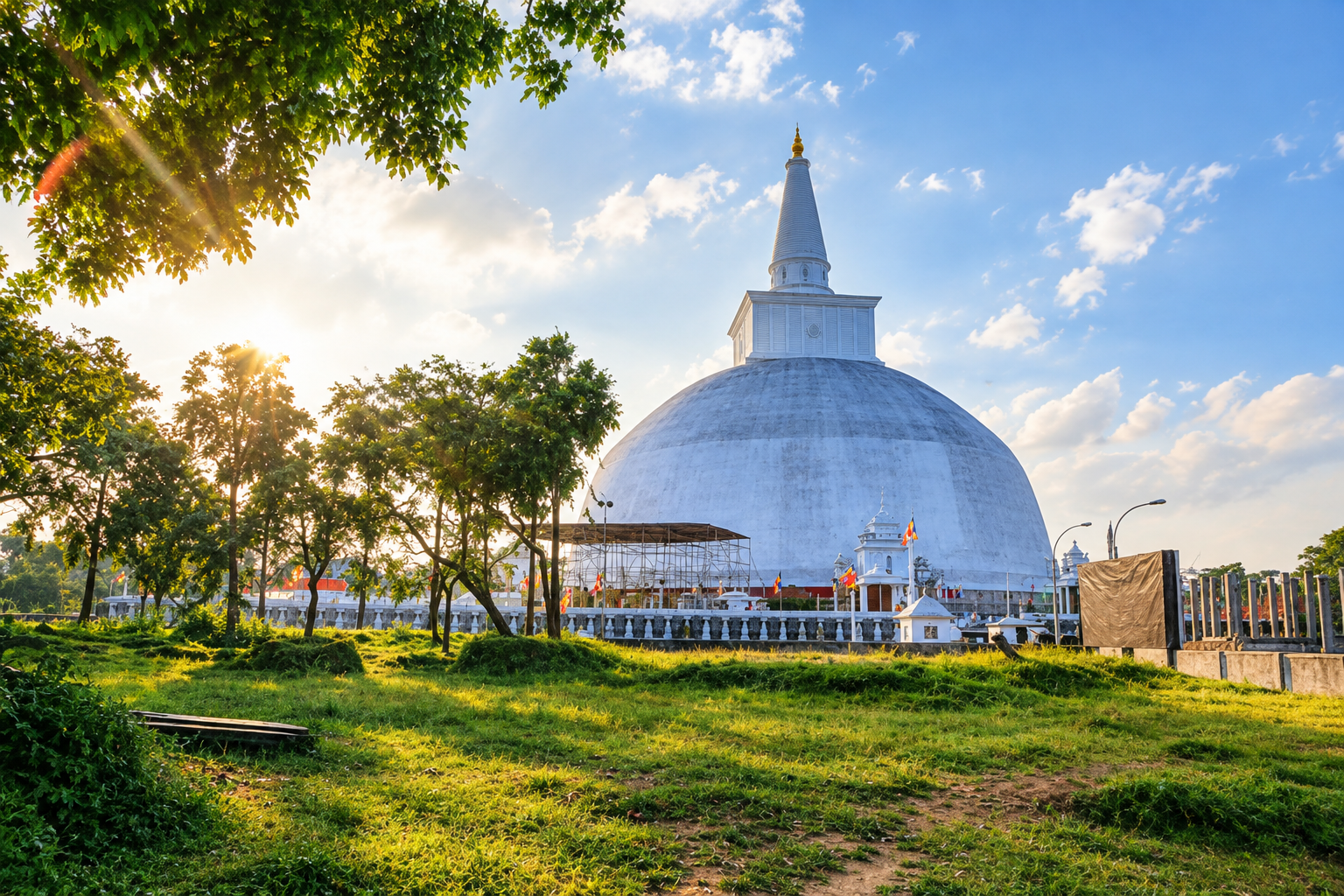
A short distance from the Bodhi tree rises Ruwanwelisaya, one of the defining monuments of Anuradhapura. Its enormous white dome dominates the sacred landscape and remains an active focus of Buddhist devotion.
The stupa is traditionally associated with King Dutugemunu in the 2nd century BCE. Around its precinct, the visual scale of the monument is matched by the atmosphere: pilgrims circle the stupa, flowers are arranged as offerings, and the white dome changes character with the light throughout the day.
For many travelers, Ruwanwelisaya is most memorable in the softer light of early morning or evening, when the temperature is comfortable and devotional activity can be especially moving.
THUPARAMAYA
Thuparamaya occupies a special place in Sri Lanka's Buddhist history. UNESCO reporting notes that the Thuparama dagaba was built in the 3rd century BCE during the reign of King Devanampiya Tissa to enshrine a relic of the Buddha.
Although smaller in scale than Anuradhapura's giant stupas, its historical and religious significance is considerable. It reminds visitors that importance in Anuradhapura is not measured only by size.
JETAVANARAMAYA: MONUMENTAL BRICK ARCHITECTURE
Jetavanaramaya is one of Anuradhapura's most imposing archaeological sights. Official Sri Lanka Tourism material states that the monastery developed around the Jetavana Stupa, constructed by King Mahasena in the 3rd century CE.
Even in its surviving form, the immense brick mass conveys the engineering ambition of ancient Anuradhapura. The wider monastic complex was more than a single stupa: it formed part of a major institutional landscape of ritual, residence and learning.
Give the monument space. Standing farther away before approaching helps you understand its scale much better than viewing it only from the base.
ABHAYAGIRI MONASTERY
Abhayagiri was another of Anuradhapura's great monastic centres. Sri Lanka Tourism dates the construction of its principal stupa to the reign of King Valagambahu in the 1st century BCE and describes a vast monastery containing numerous monuments.
The Abhayagiri landscape includes the great stupa as well as celebrated archaeological features such as Kuttam Pokuna, the Samadhi Buddha and other monastic remains. Exploring this area reveals how large and sophisticated Buddhist institutions became within the ancient capital.
KUTTAM POKUNA - THE TWIN PONDS
Kuttam Pokuna, or the Twin Ponds, is among Anuradhapura's most elegant examples of ancient water-related architecture. The carefully constructed bathing ponds, stone steps and associated water-control features demonstrate the attention given to both function and design within monastic life.
The ponds also provide a useful contrast with the city's monumental stupas. Anuradhapura's engineering achievements were not only about building upward; they also involved managing water across a dry-zone environment.
THE SAMADHI BUDDHA
Within the Abhayagiri area, the Samadhi Buddha is one of Anuradhapura's best-known stone images. The seated figure is associated with deep meditative composure, and its quiet presence creates a very different experience from the monumental scale of the nearby stupas.
Visitors should treat the image as a sacred representation, not merely an object for posed photography.
MOONSTONES, GUARD STONES AND STONE ART
Some of Anuradhapura's finest details are easy to miss when attention is focused only on the largest monuments. Ornamental moonstones, guard stones, balustrades and carved architectural fragments reveal the refinement of ancient Sri Lankan stone craftsmanship.
A knowledgeable guide can be especially valuable here, helping explain how decorative elements functioned within entrances, monasteries and ritual architecture.
THE ANCIENT RESERVOIRS
Anuradhapura could not have flourished at such scale without sophisticated water management. UNESCO's documentation recognizes artificial reservoirs as a major attribute of the ancient city's landscape.
Large tanks such as Tissa Wewa and Nuwara Wewa belong to a broader hydraulic tradition that captured and distributed water in Sri Lanka's dry zone. These systems supported agriculture, urban life and religious institutions and became one of the defining achievements of ancient Sri Lankan civilization.
For modern travelers, the reservoirs also soften the archaeological landscape, creating open water, birdlife and beautiful evening views.
A CITY OF MONASTIC RINGS
UNESCO documentation describes Anuradhapura through its citadel, monastic establishments and reservoirs. Rather than imagining one dense center of ruins, it is more accurate to think of an extensive sacred and urban landscape with major monastic institutions arranged across broad areas.
This scattered nature is precisely why visitors should plan transport and route order in advance.
WHY THE CITY DECLINED
Anuradhapura survived repeated political conflict across its long history. UNESCO's World Heritage description states that the capital flourished for about 1,300 years before being abandoned after an invasion in 993 CE.
Political power shifted toward Polonnaruwa, which became Sri Lanka's next great medieval capital.
Anuradhapura's sacred significance, however, did not disappear. Its religious monuments and pilgrimage traditions continued to shape Sri Lankan Buddhist identity.
HOW MUCH TIME DO YOU NEED?
Anuradhapura is one of the worst places in Sri Lanka to rush.
A half-day can introduce the principal monuments, but it requires careful prioritization. A full day is much better for first-time visitors who want to see the major sacred sites and archaeological areas without turning the journey into a checklist.
Travelers with a serious interest in Buddhism, archaeology, architecture or photography can comfortably spend longer, especially when Mihintale is included.
GETTING AROUND THE SACRED CITY
The monuments are spread over a large area. A private vehicle with planned stops is comfortable and efficient, particularly in hot weather. Cycling can be rewarding for active travelers, while tuk-tuks are another practical way to move between sites.
Walking alone is not ideal for covering the entire archaeological zone in one day because of the distances and heat. Whatever transport you choose, include time to walk within each sacred precinct rather than viewing monuments only from the roadside.
BEST TIME OF DAY
Early morning is excellent for the Jaya Sri Maha Bodhi, Ruwanwelisaya and other sacred sites. Temperatures are cooler, light is gentle and the atmosphere often feels particularly devotional.
Late afternoon and early evening can also be beautiful around the great stupas and reservoirs. Midday is usually better used for lunch, rest or shaded museum and archaeological stops where appropriate.
A split-day plan can therefore be more comfortable than continuous sightseeing through the strongest heat.
WHAT TO WEAR AND BRING
• Modest, lightweight clothing that covers shoulders and knees at sacred sites
• Footwear that is easy to remove and put back on
• Socks for hot ground where their use is permitted
• Drinking water and sun protection
• A hat for non-sacred outdoor areas; remove it where required
• A small umbrella or light rain layer depending on weather
• A camera or phone used respectfully around worshippers and sacred images
TEMPLE ETIQUETTE
Anuradhapura remains a living sacred city, so respectful behavior is essential. Remove shoes and hats where required. Dress modestly. Avoid loud conversation during worship. Do not touch sacred objects or climb on archaeological structures.
Be thoughtful when photographing Buddha images. In Sri Lanka, posing with your back directly toward a Buddha statue for a casual photograph can be considered disrespectful. When in doubt, observe local behavior or ask a guide.
Give pilgrims space. A religious ceremony should never be interrupted for a photograph.
PHOTOGRAPHY
Anuradhapura rewards photographers who think beyond individual monuments. Wide compositions can show the relationship between stupas, trees, pilgrims and open landscape, while detail photographs reveal stone carving and architectural texture.
Early and late light is especially effective on white stupas and brick monuments. At active sacred sites, discretion matters more than obtaining every possible image. Professional shoots, drones or specialized equipment may require permissions; verify current rules with the relevant authorities.
TICKETS AND PRACTICAL INFORMATION
Ticketing arrangements, prices, access rules and opening hours can change. Travelers should check current official information close to the travel date rather than relying on an old online price.
Anuradhapura also contains active religious precincts alongside ticketed archaeological areas, so the visitor experience does not operate like a single enclosed attraction. A well-planned route helps avoid confusion and unnecessary backtracking.
ANURADHAPURA AND MIHINTALE
Mihintale is one of the strongest additions to an Anuradhapura itinerary. Sri Lankan Buddhist tradition associates the hill with the meeting between Mahinda and King Devanampiya Tissa and therefore with the introduction of Buddhism to the island.
Combining the two creates a more coherent historical story: Mihintale provides the landscape of Buddhism's arrival, while Anuradhapura reveals the institutions, monuments and sacred traditions that grew from it.
ANURADHAPURA OR POLONNARUWA?
The two ancient capitals complement each other.
Anuradhapura is older, larger and more strongly experienced as a living sacred landscape. Its great stupas, monasteries and pilgrimage sites are spread across a wide area.
Polonnaruwa belongs to a later period and often feels more compact as an archaeological city, with monumental medieval ruins that can be explored in a more concentrated route.
Travelers interested in Sri Lanka's history should ideally experience both rather than choosing one as a substitute for the other.
SUGGESTED CEYLON VELO FULL-DAY ROUTE
Early morning: Begin at Jaya Sri Maha Bodhi while the day is cooler and the sacred precinct is active with worship.
Morning: Continue to Ruwanwelisaya and Thuparamaya, taking time to understand the religious relationship between the monuments rather than moving immediately onward.
Late morning: Explore Jetavanaramaya and selected archaeological features before the strongest heat.
Midday: Take a proper lunch and rest break.
Afternoon: Explore the Abhayagiri complex, including selected features such as Kuttam Pokuna and the Samadhi Buddha.
Late afternoon: End beside a major stupa or reservoir as the light softens. If Mihintale is included, the entire day should be rebalanced rather than simply adding it to an already full schedule.
RESPONSIBLE TRAVEL
The Sacred City of Anuradhapura belongs simultaneously to archaeology, national heritage and living religion. Travelers should therefore avoid treating the monuments as backdrops disconnected from local meaning.
Stay on appropriate paths, do not climb ruins, do not leave waste, follow conservation instructions and respect religious ceremonies. Buy water and services responsibly, and support knowledgeable local guides where possible.
FREQUENTLY ASKED QUESTIONS
Is Anuradhapura worth visiting?
Yes, especially for travelers interested in Sri Lankan history, Buddhism, architecture or ancient engineering. It is one of the island's foundational cultural destinations.
How long should I spend there?
A full day is ideal for many first-time visitors. Half a day is possible with careful selection, while heritage enthusiasts may want longer.
Is Anuradhapura a UNESCO World Heritage Site?
Yes. The Sacred City of Anuradhapura was inscribed on the UNESCO World Heritage List in 1982 under criteria (ii), (iii) and (vi).
What is the most sacred site?
The Jaya Sri Maha Bodhi is among the most revered Buddhist sites in Sri Lanka and lies at the spiritual heart of the sacred city.
Can I explore by bicycle?
Yes, cycling is popular among active travelers, but distances, heat and road conditions should be considered. A vehicle is more comfortable for travelers who want to conserve energy.
Do I need a guide?
Not strictly, but Anuradhapura benefits greatly from interpretation because the sites span many centuries and religious traditions. A knowledgeable guide can turn scattered monuments into a coherent historical story.
Can I visit Anuradhapura and Mihintale on the same day?
Yes, but the day needs careful planning. Trying to see every major Anuradhapura monument plus Mihintale can become rushed.
Are the sites still used for worship?
Many are. That living religious character is one of the most important things to understand about Anuradhapura.
FINAL THOUGHTS: A CITY THAT NEVER BECAME ONLY A RUIN
Anuradhapura's greatest monuments are ancient, but the city does not feel dead.
The Jaya Sri Maha Bodhi is still approached with offerings. Pilgrims still circle the great stupas. Monastic traditions remain part of the landscape. Reservoirs still shape the environment. Archaeology and devotion occupy the same ground.
That continuity is what distinguishes Anuradhapura from many ancient cities around the world. Its importance is not only that a great civilization existed here, but that parts of its spiritual world remain visible and active.
Give Anuradhapura time. Remove your shoes. Walk slowly around a stupa. Watch the offerings beneath the Bodhi tree. Then move outward into the monasteries, ponds, stone carvings and reservoirs that reveal the scale of the ancient capital.
At Ceylon Velo, we design Anuradhapura as a story unfolding across a landscape, not as a race between monuments.
ONE ISLAND. ENDLESS EXPERIENCES.
Plan Your Anuradhapura Journey
Let us connect Anuradhapura with Mihintale, Sigiriya, Dambulla and Polonnaruwa in a Cultural Triangle journey shaped around your interests, comfort and pace.
Written By
Ceylon Velo
Lead Travel Curator at Ceylon Velo with a passion for uncovering the untold stories of the island.
Join the Journey
Subscribe to receive exclusive travel guides and island stories directly in your inbox.